
If you’re a small-scale business owner looking to be discovered on the internet, you’ve probably noticed something: local searches has changed from what it used to be. Google’s algorithms are becoming more sophisticated, more personalised and are increasingly driven by artificial intelligence. What worked in 2023 could be a bit stale in 2026.
The positive side? Local SEO remains one of the most effective methods to draw buyers who are eager to purchase. If someone types in “plumber nearby my home” or “best coffee shop in Portland,” Google shows businesses that satisfy certain requirements for ranking. Knowing the Local SEO Ranking Factors by 2026 isn’t a luxury anymore; it’s vital to survive in the increasingly competitive digital world.
This guide will explain the most important factors when it comes to local search and how Google’s algorithm has changed, and what small businesses can do to be better in local packs and AI-generated results. If you’re trying it yourself or seeking help from a professional, Learn how to develop an effective Local SEO strategy that works.
Core Local SEO Ranking Factors in 2026
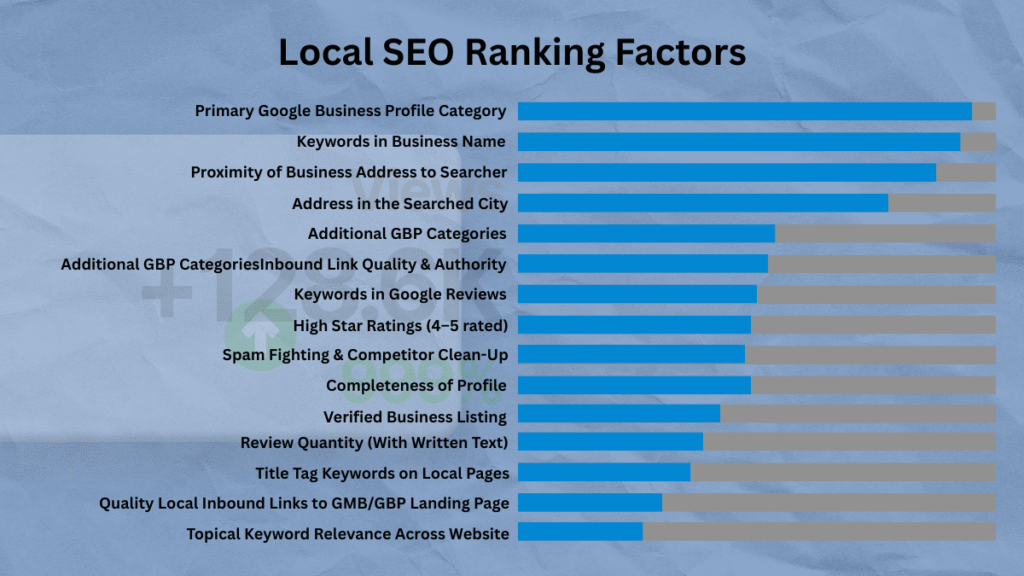
Google utilizes numerous signals in order to decide which local businesses are listed in results. However, not every factor has equal importance. These is a list of ranking indicators that count the most in 2026.
AI-Powered Search Relevance
Google’s AI algorithms now evaluate the intent of searches with amazing accuracy. When someone is searching for “emergency dentist” Google understands urgency and prioritizes businesses that are open on the same day and a positive review rating for emergency services and clear messages regarding urgent services.
What does this mean for you is that your content should be able to match the intent of users precisely. The generic descriptions will not do it. Be specific about the services you provide and who you are serving and the problems you address.
Proximity and User Behaviour Signals
Distance between the user and searcher is still important, however Google has now taken into account behaviour patterns. If people drive by the closest competitors to come to your company, Google interprets this as an indication of quality.
The algorithm also monitors the level of engagement, such as the number of people who click on your advertisement, dial your number, ask for directions, or visit your site and the length of time they spend there. A high level of engagement shows Google that your company is in the right place.
Google Business Profile Optimisation
Google Business Profile optimisation remains one of the strongest Local SEO Ranking Factors, directly impacting map pack visibility and local rankings.
Important elements include:
- Affirmation of the correct address, name of business, and telephone number (NAP)
- Business category that is correct (primary and secondary)
- A detailed description of the business with pertinent keywords
- Regular updates and posts
- Videos and photos of high quality.
- Service areas that are accurate and hours of operation
- Attributes (wheelchair accessible, Outdoor seating, wheelchair accessible, etc.)
Reviews and Reputation Signals
Reviews have always been important. However, by 2026, Google’s AI will analyse review content and sentiment, recency and patterns of response using sophisticated natural processing of language.
What is Google’s evaluation of: Google assesses:
- Review quantity total (more than one review is more beneficial)
- Review speed (consistent reviews, which indicate a growing business)
- Quality of rating (4.0or more stars are the best)
- The importance of keywords in reviews
- Owner replies (fast and helpful responses improve rankings)
- Review the diversity (across different platforms)
Companies with more than 50 recent reviews and ratings and active owners outrank companies with fewer reviews.
Local Backlinks and Citations
Citations are online citations of your company’s name, address, and the number of your phone. Congruity of NAP information across directories such as Yelp, Yellow Pages, Facebook and specific sites for the industry informs Google that your business is legitimate.
Local backlinks from local newspapers, chambers, blogs from local businesses and community groups indicate the authority and importance of the geographic region.
On-Page SEO Signals
Your website is still vital to local rankings. Google evaluates:
- NAP uniformity (your address and your phone number should be the same all over the world.)
- Markup Schema (LocalBusiness Structured Data)
- Content and pages that are based on location
- Authority in the field (depth of information about your products)
- Internal linking structure
Mobile Speed and User Experience
Google’s mobile-first index implies that the mobile performance of your site directly impacts your rankings. The Core Web Vitals, speed of loading as well as interactivity and visual stability are all established ranking elements.
Websites that load in less than 2 seconds and offer seamless mobile experience rank higher in conversion and are more effective at converting.
Local Content Depth
The absence of quality content can affect rankings. Google recognizes businesses that show proficiency through quality, informative content. This includes blog posts on local events, pages on service area FAQs, case studies cases studies, as well as guides to address customer concerns.
Brand Trust Signals
Google examines trustworthiness by using several lenses: secure websites (HTTPS) privacy policies and clear contact details, legitimate business registrations and brand mentions throughout the internet. Companies with good digital footprints and favorable reputations are ranked higher.
Step-by-Step Guide for Small Businesses to Improve Local Rankings
These steps directly align with the most local seo ranking factors & help small businesses compete effectively in local search.
Step 1: Claim and Optimise Your Google Business Profile
Claim or create your profile on business.google.com. Completely fill out each section. Select the most accurate primary category, and then add any appropriate secondary categories. Create a descriptive, keyword-rich text that clarifies what you do and where you are located.
Step 2: Build a Citation Foundation
Make sure you have your NAP is consistent across the major directories like Yelp, Facebook, Apple Maps, Bing Places, Better Business Bureau, and directories that specialize in your industry. Utilize tools such as Moz Local or BrightLocal to find any inconsistencies.
Step 3: Implement Local Schema Markup
Include a LocalBusiness schema on your web page’s code. Include your business’s name address, phone number hours, areas of service and accepted payment methods. This will help Google comprehend and display your details accurately.
Step 4: Create Location-Specific Pages
If you have multiple areas of service Create separate pages for each area or city. Each page should contain specific information about the way you service that particular region, as well as locale landmarks and testimonials from clients from the location, as well as maps that are embedded.
Step 5: Launch a Review Generation System
Review reviews of satisfied customers via text, email, or in person. It’s easy to do this by providing links directly. Response to all reviews, both positive and negative within 24-48 hours.
Step 6: Build Local Backlinks
Get involved in local events, be a part of with your local chamber of commerce. be mentioned in local media and partner with other businesses and develop content that is shareable locally and earns links on the fly.
Step 7: Optimise for Mobile Speed
Check your website using Google’s PageSpeed insights. Reduce images, allow browser caching, reduce the code, and think about the use of a content delivery network (CDN).
Step 8: Publish Regular Local Content
Create blog posts on local events such as news, customer stories, news and service announcements. This shows your commitment to the community and also provides new material to Google to search for and index.
These strategies are the backbone of a successful SEO in local areas for small businesses. Consistency and persistence matter more than perfection–businesses that execute these fundamentals consistently win over time.
Using these strategies to rank regularly will improve your visibility and bring in new local clients. Understanding the factors that affect ranking is vital, a lot of business owners are still unsure of the expense required to invest in search engine optimization local to their area.. For a comprehensive description of the costs, packages and ROI estimates read our comprehensive guide to local SEO pricing for the year 2026. focusing on strategy and an investment plan that is appropriate will allow you to maximize your results and remain on top in your local market.
Top local seo ranking factors by Impact
| Ranking Factor | Impact Level | Time to See Results | Difficulty |
|---|---|---|---|
| Google Business Profile Optimisation | Critical | 2–4 weeks | Easy |
| Reviews (Quantity & Quality) | Critical | 1–3 months | Medium |
| NAP Consistency | High | 4–8 weeks | Easy |
| Local Backlinks | High | 3–6 months | Hard |
| Mobile Speed & UX | High | 2–6 weeks | Medium |
| On-Page SEO Signals | High | 6–12 weeks | Medium |
| Click-Through Rate | Medium–High | 4–8 weeks | Medium |
| User Behavior Signals | Medium–High | 2–4 months | Hard |
| Google Posts Frequency | Medium | 2–4 weeks | Easy |
| Local Content Depth | Medium | 2–4 months | Medium |
Common Mistakes Small Businesses Make in Local SEO (and How to Fix Them)
Even business owners with good intentions commit serious mistakes that can hinder rankings
Non-concordant information for NAP Your address is “123 Main St” on Google, “123 Main Street” on Yelp and “123 E Main St” on your website. This is confusing Google and weakens the authority. Get it fixed by introducing a common NAP all over the world.
Avoiding Negative Reviews Unanswered reviews can harm credibility and rank. Be professional, respond to the issue, and provide solutions in public.
Keyword Stuffing The practice of putting “best plumbers to work in Phoenix” to every phrase appears to be spammy. Write with a natural human voice first, and then optimize it strategically.
Doing nothing to improve mobile experience on your website If your site does not load fast and looks amazing on mobile devices, you’re losing rankings and clients. Make sure you optimize your mobile site.
Selecting the Wrong Categories The principal Google Business category must precisely correspond to your primary service. Restaurants that are classified as “bar” will be in trouble when you search for “restaurant close to me” searches.
Buy Fake Reviews Google’s AI detects fraudulent reviews. Penalties could permanently affect your credibility. Earn reviews legitimately.
not tracking results Flying blind is a waste of money. Utilize Google Business Insights, Google Analytics along with call trackers to determine the results.
Beware of these mistakes and following the basics consistently will make you more successful than 80% of your local competition.
Why Working With a Professional Local SEO Agency Matters
Though DIY SEO local is feasible but professional help speeds up results and helps avoid costly errors.
A qualified agency can provide:
Technical Knowledge They are aware of algorithm updates as well as the schema’s implementation and mobile optimisation and the best way to identify problems with ranking swiftly.
Speed Efficiency Instead of putting in more than 20 hours per month studying and performing SEO, you concentrate on running your business, while experts manage optimisation.
Tested and Proven. The agencies have created methods for building citations, linking, link acquisition, creating of content, and generating of reviews that provide consistently good results.
Competitive Intelligence It analyzes what’s working in your industry and modify strategies accordingly.
Risk mitigation: Professional firms employ white-hat methods that are in line with Google’s guidelines, safeguarding your company from being penalised.
If you are choosing an agency be sure to look for transparency in pricing and communication, as well as real-time timelines (beware of promises for instant results) and a track record of successful cases in your field.
FAQ
What will local SEO costs in 2026?
Local SEO usually costs between $500-$3,000 monthly for services that are professional, based on market competition and size. DIY options cost less but require significant time investment. The initial setup costs typically are between $1,000 and $5,000. The typical investment returns 5-10x in new revenue for customers in 6 to 12 months.
Which is the primary local SEO ranking element?
There are many aspects to consider, but Google Business Profile optimisation combined with recent and high-quality reviews can have the greatest influence on rankings. Companies with complete profiles, at least 50 positive reviews, and constant owner engagement are typically the top of local results in search results.
How long will local SEO take to be effective?
Most businesses will see improvement within 3-6 months, with higher rankings and better visibility. Revenue and traffic increases of significant magnitude generally occur between 6 and 12 months. Search engine optimization for local is a strategy for long-term success. Consistent effort is a long-term strategy that grows over time.
Local SEO services worthwhile for small-sized businesses?
If you choose it correctly. Local SEO typically has greater ROI than traditional advertisements due to the fact that it targets people who are who are actively seeking your services. An effective strategy typically costs less than traditional marketing while providing more qualified leads.
Can I do local SEO myself?
Absolutely, particularly if eager to learn and commit time regularly. Professional services can help you speed up outcomes and help avoid common errors that can take months of work. A lot of businesses begin DIY, but engage professionals once they recognise the importance.
Take Control of Your Local Visibility in 2026
Local SEO Ranking Factors in 2026 are more advanced than ever before, yet the chance for small-sized businesses has never been better. While big companies struggle to adjust to AI-powered searches and more personalized results, local businesses can be a major force in their competition by implementing these basic principles consistently.
Success doesn’t require perfection–it requires action. Begin by creating an initial Google Business Profile, build an initial foundation of reviews and citations, improve your website for mobile visitors and produce content that showcases your knowledge. These actions alone will place you ahead of your competitors.
If the technical elements seem overwhelming or you don’t have the time to do it consistently Professional assistance can speed up your time-to-market and boosts the return on investment. The best local SEO solutions give you the expertise, tools and accountability that improve your web presence.
Small businesses that succeed in 2026 will not be the ones with the largest budgets, but they will be those that understand Local SEO can be a source of sustainable development, but not a cost to reduce.
Are you looking for greater Google Map rankings and a continuous flow of qualified leads?
Let’s build a local SEO strategy that is specifically tailored to your company. Book your consultation today and begin attracting more customers on the next day.