If you’ve noticed your organic traffic behaving strangely in 2026 – impressions climbing while clicks fall, or rankings holding steady but leads drying up – you’re not imagining it. Google’s AI and LLM updates have fundamentally rewritten the rules of search visibility. The question isn’t whether SEO has changed. It’s whether your strategy has caught up.
This blog breaks down exactly what’s happening, what the data shows, and what you need to do to stay competitive.
The AI Takeover of Google Search
Search in 2026 looks almost nothing like it did two years ago. Google has effectively merged its AI Overviews, Gemini, and classic search into one unified experience – powered globally by the Gemini 3.5 Flash model that rolled out alongside the May 2026 Core Update.
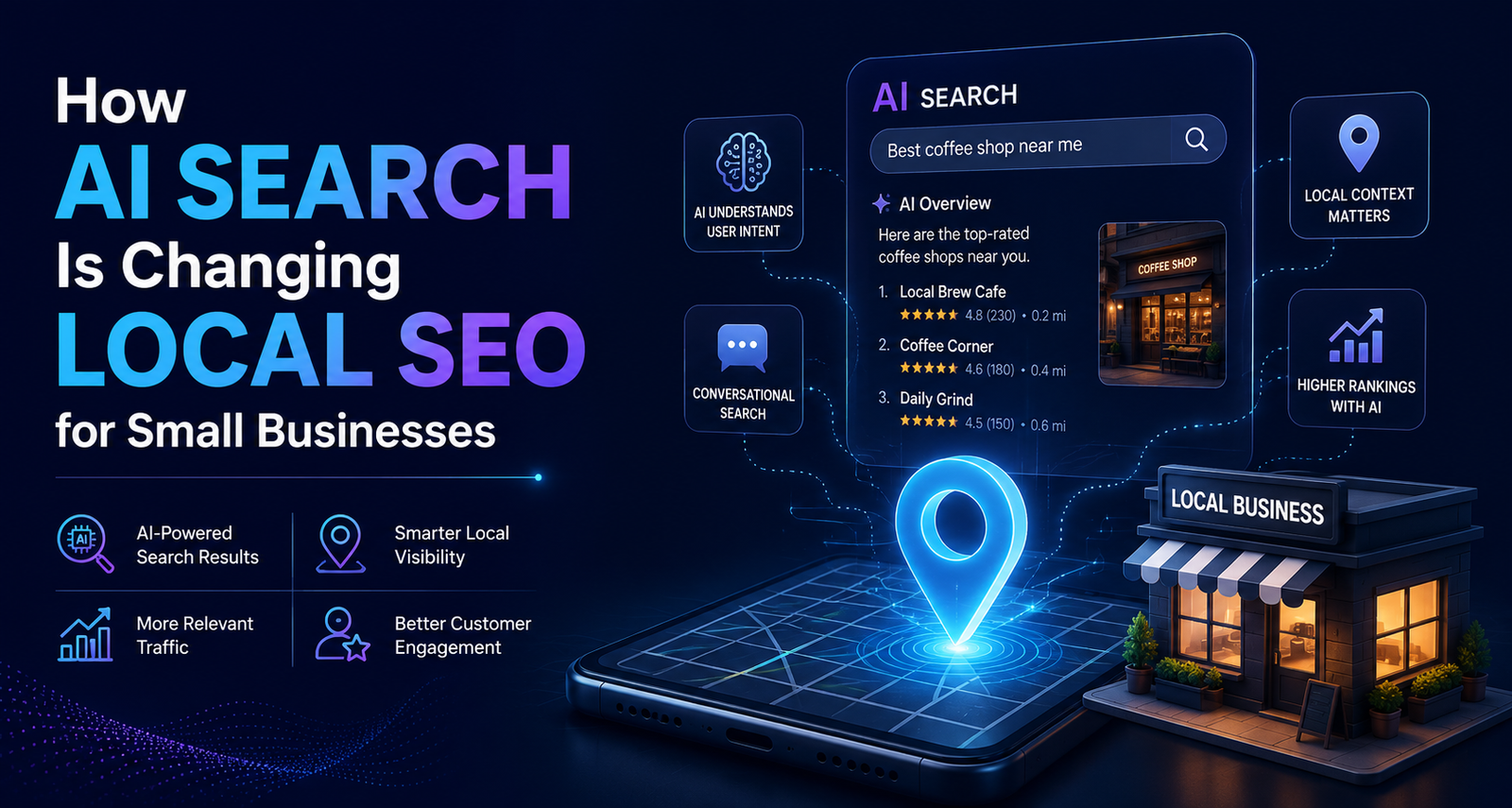
AI Overviews now appear on approximately 47–64% of all search queries across desktop and mobile. In high-intent verticals like health, finance, technology, and education, that number climbs above 70%. That means more than half of all searches now encounter an AI-generated summary before they ever see a traditional organic result.
The impact on click-through rates has been severe. Studies from Semrush and Ahrefs confirm a 30–50% average reduction in CTR on queries where AI Overviews appear. Position one organic CTR on those queries has dropped from 27% to as low as 11%, according to SISTRIX data from March 2026.
Here’s the kicker: zero-click searches now account for 58.5% of all US Google searches (SparkToro, 2026). More than half of all search sessions end without a single outbound click. If your SEO strategy was built on traffic volume alone, this is the reality check you needed.
Ranking #1 No Longer Guarantees You’re in the AI Overview
This is perhaps the most disorienting shift for SEO professionals in 2026. Historically, ranking in the top three meant visibility. That’s no longer the case.
The Gemini-3 rollout in January 2026 appears to have permanently decoupled traditional ranking from AI Overview inclusion. The overlap between organic top-10 results and AI Overview citations has dropped from around 76% in mid-2025 to somewhere between 17% and 54% in early 2026, depending on the study. Ranking #1 no longer guarantees you’ll be cited in the AI summary above it.
AI Overviews now pull from an average of 13.34 sources per response – up from roughly 6.82 in 2024. This wider citation pool means the game has changed: it’s no longer enough to rank. You need to be the kind of source that AI systems trust enough to cite.
What Google’s Major 2026 Updates Actually Mean
March 2026 Core Update: Domain Authority Over Page Optimization
The March 2026 Core Update sent a clear structural signal: domain-level authority is now outweighing page-level optimization. Sites that publish comprehensively within a single subject area – covering every angle, every sub-topic, in multiple content formats – significantly outperformed broad sites that touched many topics at shallow depth.
The update also re-weighted what’s known as “Information Gain” – a ranking signal measuring how much genuinely new knowledge a piece of content adds relative to what already exists. The question Google is now effectively asking: If your content disappeared from the internet tomorrow, would anyone lose access to information they couldn’t find somewhere else? If the answer is no, your content is at risk.
May 2026 Core Update: The End of Low-Effort Content
Launching alongside Google I/O announcements, the May 2026 Broad Core Update took an aggressive stance against what Google calls “commodity content” – generic, widely available information that an AI could generate itself. Google’s own Search Liaison Danny Sullivan has warned that content which is interchangeable or easily replicated will not perform in this new environment.
The update specifically targets:
- Mass-produced AI-generated blog posts with no original media or human perspective
- Sites buying old domains to piggyback on unrelated authority
- Backlink manipulation schemes supporting low-quality content
If your agency or marketing team has been scaling content output without scaling content quality, this update is directly aimed at you.
Google I/O 2026: AEO and GEO Are Now Just SEO
Perhaps the most clarifying statement from Google I/O 2026 came from Google’s own May 2026 guide, which confirmed: there is no separate strategy for AI search. Answer Engine Optimization (AEO) and Generative Engine Optimization (GEO) are simply foundational SEO applied to an AI surface.
The New Visibility Currency: AI Citations
Being cited inside an AI Overview is now commercially more valuable than holding the top organic position below it.
Data published by Digital Applied in March 2026 shows that brands cited inside AI Overviews earn 35% more organic clicks and 91% more paid clicks compared to non-cited competitors on the same queries. That gap is the most important metric in search right now – and most businesses aren’t measuring it.
A Search Engine Journal study analyzing 11 sites affected by Google’s January 2026 update found that sites that lost organic traffic also saw an average 22% decline in AI search citations across all AI models. Traditional SEO and LLM visibility are correlated. You cannot build one without the other.
What Actually Gets You Cited by AI and LLMs in 2026
1. Original, Expert-Attributed Content
AI systems – whether Google’s, ChatGPT’s, or Perplexity’s – share a consistent citation profile: content that is original, expert-attributed, and topically authoritative. Generic summaries that AI can generate itself carry zero citation value. Only content reflecting genuine expertise, original research, or first-hand experience earns inclusion.
Use AI as a drafting tool, not a publishing tool. Content assisted by AI but substantially edited by a named human expert, grounded in original perspective, performs well under Google’s E-E-A-T standards.
2. Content Depth and Structure
Articles over 2,900 words average 5.1 AI citations, while those under 800 words get 3.2, according to SE Ranking data. Pages using 120–180 words between headings receive 70% more ChatGPT citations than pages with sections under 50 words. Question-based headings and FAQ sections also meaningfully boost AI citation rates.
3. Structured Data – Now Table Stakes
Structured data is no longer optional for AI Overview visibility. Essential schema types include Article Schema with author, datePublished, and dateModified markup, FAQ Schema for question-answer content, and nested Schema types where appropriate. Use JSON-LD format, which is Google’s preferred method.
4. Multi-Platform Brand Presence
Reddit holds 21% of AI Overview citations. YouTube has overtaken Reddit as the most-cited source across LLM answers overall. Brands winning the AI search transition are building presence on YouTube, Reddit, LinkedIn, and G2 – not just their own website. Consistent brand entity information across all platforms helps AI systems build a clear, reliable profile for your business.
5. Freshness
Content updated within the past three months averages 6 AI citations versus 3.6 for outdated pages. Regular content refreshes aren’t just good practice- they’re a measurable citation signal.
What to Stop Doing Right Now
Google’s May 2026 guide also names tactics that are wasting budget and carrying active downside risk:
- Don’t break content into small AI-optimized chunks. Google’s systems parse full pages and extract relevant passages. Danny Sullivan of Google confirmed in January 2026 that engineers specifically advised against this approach.
- Don’t seed fake brand mentions across forums or social platforms. Spam filtering systems actively detect and penalize manipulation.
- Don’t chase keyword volume without topical depth. Publishing fewer, deeply researched articles within a specific niche will outperform high-volume, shallow coverage every time.
The Bottom Line for SEO in 2026
The formula that worked for the last decade – rank well, get clicks, capture leads – is no longer a reliable chain. The businesses winning in 2026’s AI search landscape are doing something different: they’re building genuine authority, publishing original insights, and making their content as clear, credible, and trustworthy as possible – for both human readers and AI systems.
The good news? The brands being cited in AI Overviews are converting better. Less irrelevant traffic, more high-intent visitors. The shift is painful for publishers dependent on ad revenue from volume clicks, but for service businesses and agencies, AI search rewards quality over quantity in a way Google never quite managed before.
The future of SEO isn’t about driving more traffic. It’s about earning visibility where trust and expertise matter most.