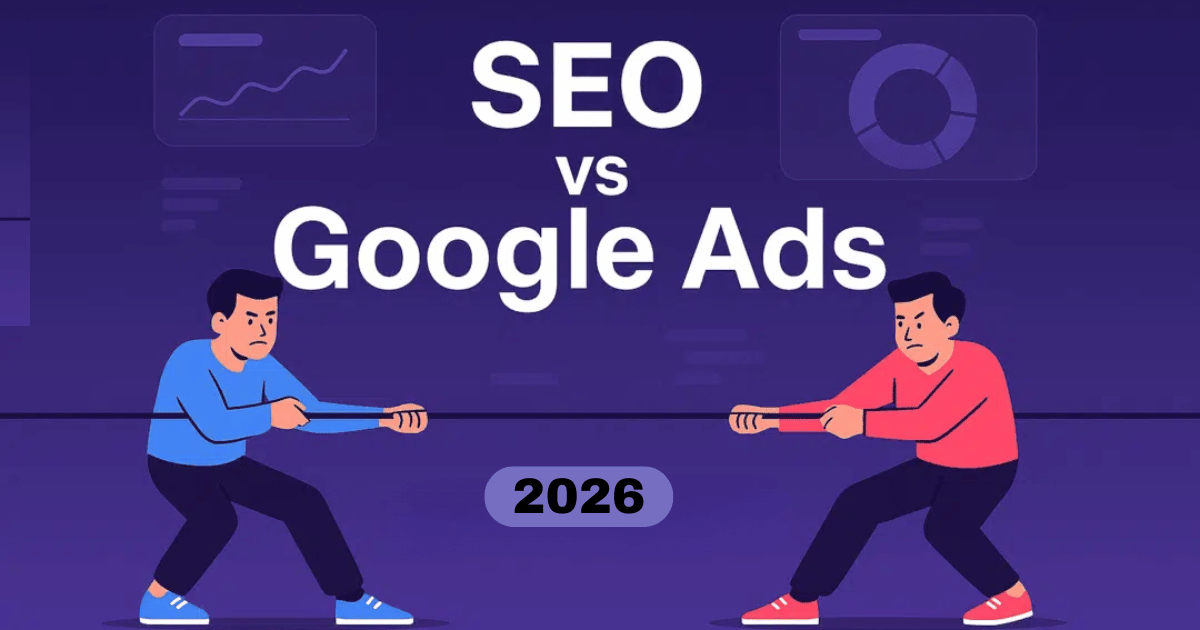
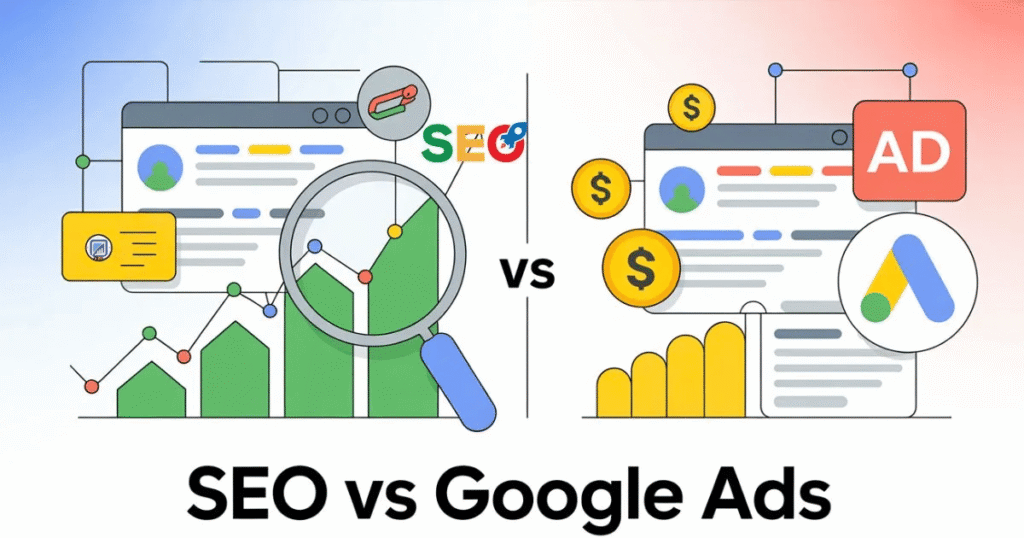
There’s no universal answer when it comes to SEO vs Google Ads. SEO (Search Engine Optimization) helps build long-term organic traffic, trust, and strong organic search rankings, but it usually takes 3–6 months to show real results. Google Ads, on the other hand, delivers immediate visibility and faster leads through paid search advertising, but the traffic stops the moment you stop paying. For most businesses, the smartest approach is to combine both – using Google Ads for quick wins while building sustainable organic growth through SEO for long-term ROI.
What is SEO? (Search Engine Optimization)
SEO is the process of enhancing your website’s performance to appear higher on search engine result pages (SERP) without the expense of advertisements. If someone is searching for “plumber nearby my home” or “best CRM software”,” SEO helps your website be found in organic results, which is in contrast to the paid advertisements.
Search Engine Optimization includes optimization of content and website optimization, as well as technological fixes, linking building, and search engine optimization. The benefit of SEO is the fact that, once you have a rank, you will receive organic traffic on a continuous basis without the need to pay per click. It requires constant effort and perseverance to keep positions.
What is Google Ads? (Paid Search Advertising / PPC)
Google Ads is Google’s pay-per-click (PPC) advertising platform that lets businesses bid on keywords in order to place advertisements in the uppermost position of results for search. Pay only when someone clicks on your advertisement and it is the only one that’s performance-based.
The key elements include keyword targeting and bid management and ad creation and landing pages, as well as budget control. Google Ads offers immediate visibility–your advert can be seen on the first page within hours of its launch. This means that PPC is the ideal choice for promotions that are time-sensitive or companies that require leads quickly.
SEO vs Google Ads – Key Differences
| Factor | SEO | Google Ads |
| Cost | Monthly service fees; no per-click costs | Monthly budget for advertising plus management costs |
| Speed | Minimum of 3-6 months | In the immediate (hours from hours to days) |
| Long-term ROI | Compounds are formed over time. | Stops at the time budget expires |
| Trust | Greater trust among users | Trust is lower (labeled by ads) |
| Best For | Long-term growth | Quick wins, adversity |
Pros and Cons of SEO
Pros of SEO
Cost-effectiveness as time passes -After you have ranked organically, it’s essentially free. You don’t have to pay for each visit, which makes the ROI of your investment appealing.
Creates trust and credibility -The users prefer organic results over advertisements. The fact that you are on the first page indicates credibility and authority within your field.
A reliable source of traffic- Good rankings could last for months or even years with regular maintenance. The traffic won’t stop after you stop a campaign.
Higher rates of click-through -Organic listings usually receive more clicks than ads that are paid, particularly for informational queries.
The content is compounded in duration – The more time you invest in SEO the more visible your website grows. Old content continues attracting visitors.
Cons of SEO
Results are slow. Expect to wait three to six months before seeing substantial traffic. Websites that are new may take longer to establish an authority.
requires ongoing effort –The algorithms used to search for content are constantly changing. Continuous content creation as well as technical updates and monitoring.
Competitive in certain niches Highly competitive industries require significant investment to compete with established players.
No guarantees of rankings- Contrary to paid advertisements it isn’t possible to purchase the highest ranking. Rankings vary according to a myriad of different factors.
Algorithm dependence on HTML0 algorithm Google updates could affect rankings quickly, which requires immediate adjustments.
Pros and Cons of Google Ads
Pros of Google Ads
Instant visibility- The ads will be displayed within hours. This is ideal for businesses who require leads now and not in six months from today.
Targeting precisely- targets the device, location and time of day demographics, or even keywords from competitors.
Stable and predictable- If you discover profitable campaigns, you are able to expand your reach by increasing budget.
Data and testing- You can quickly test headlines as well as offers and landing pages. Data helps enhance both organic and paid strategies.
Budget management- Control budgets by setting daily limits. Stop or alter campaigns at any time without commitments to long-term.
Retargeting features- Retarget those who visited your website but didn’t make the switch the first time around.
Cons of Google Ads
Ongoing cost- Traffic ceases once you’ve stopped paying. There’s no future benefit.
Rising competition – Popular keywords get expensive. Some industries experience extremely high cost per click, which can cause budget pressure.
Fraudulent clicks and waste spending The reality is that not every click is converted. Budgets are able to disappear rapidly without the proper optimization.
Lower levels of trust Many people avoid advertisements completely, preferring natural results.
Requires expert knowledge Campaigns that are poorly managed will burn through money quickly. Effective PPC requires expertise in bidding, copywriting and optimization of conversion.
Affects the effectiveness of your ads As time passes your intended audience is exposed to your advertisements repeatedly, which reduces the effectiveness.
SEO vs Google Ads Cost Comparison (realistic Pricing)
SEO Monthly Cost
1. SEO vs. Google Ads: Realistic Cost Comparison
| Feature | SEO (The Long Game) | Google Ads (The Quick Tap) |
| Average Monthly Investment | moderate, consistent monthly investment | Higher, variable spend based on competition |
| Cost Basis | Retainer or Project Fee | Pay-Per-Click (CPC) |
| Speed to Results | Medium to long term (several months) | very fast (often within days) |
| Sustainability | Traffic lasts after you stop paying | Traffic stops the second you stop |
| Primary Goal | Authority & Brand Trust | Immediate Leads & Sales |
| Typical CPC/Cost | No direct cost per click once ranking | Cost per click varies by industry and competition |
SEO vs Google Ads ROI Comparison (What Gives Better Return?)
SEO generally has a greater ROI over the long term since the traffic won’t stop once you stop spending. Take this as an example:
Local law firms invest in SEO each month. In the course of six months, they are ranked for a variety of terms and generate hundreds of organic leads each month. Even if they decrease their spending, these rankings keep creating leads with little maintenance.
The company also operates Google Ads with a monthly budget. They get clicks and convert some of them into leads. To keep those leads they need to continue to spend each month.
Google Ads delivers faster ROI initially. The law firm can receive leads in just a few days, which means instant revenue growth. This cash flow can be used to finance the long-term SEO investment.
Conversion rates matter enormously. A well-optimized landing page converts an adequate percentage of traffic. Poor sites have lower conversion rates, rendering these strategies unprofitable. Tracking is crucial by using Google Analytics, conversion pixels as well as call tracking.
The final answer is: SEO offers a higher long-term return, while Google Ads provides faster results upfront.
When to Choose SEO vs Google Ads
| Choose SEO When: | Choose Google Ads When: |
| A brand that has a long-term, lasting brand visibility | We need some leads by this week, or throughout the month to get cash flow immediately |
| Your industry is a fair market with plenty of competition | The launch of a new product and testing demand on the market |
| Selling products or services that need educational content | Promoting time-sensitive events or seasonal campaigns |
| Your profit margins support patient growth (3-6 months) | In highly competitive markets, SEO requires years of experience |
| Are you looking to cut down on the costs of customer acquisition over time? | Are landing pages optimized for conversions ready? |
| Local search is vital for any business. | Need precise audience targeting capabilities |
| Do you have valuable experience to share with your content | The business has peak seasons that require the ability to adjust the amount of advertising spend |
Best Strategy: Use SEO and Google Ads Together (Recommended)
The most effective digital marketing strategy blends two approaches. Here’s why:
dominates the SERP When you rank organically and use ads, you can occupy several places on the first page. This improves brand visibility and also draws more clicks from your competitors.
Funnel strategy that is effective:
- Google Ads for fast leads Get high-intent users who are ready to purchase now. Make use of PPC for keywords in the bottom of the funnel, such as “emergency plumbing” as well as “buy the CRM program.”
- SEO to help long-term growth Establish authority through educational content aimed at the top and middle funnels of search results. It attracts prospects in the early stages who are converted later.
Make use of paid data to enhance your organic strategy — Google Ads reveals which keywords convert the best. Utilize this data for search engine optimization and keywords in SEO.
Retarget organic users: Visitors who come across you on the internet don’t always make a purchase immediately. Retarget them using Google Ads to close the sale.
Check before you commit – Start Google Ads campaigns to validate the keywords and messages. If they are successful, you can create SEO-friendly content to promote those subjects.
A home improvement company could be able to run Google Ads for “kitchen remodel contractor [city]” while also publishing blog posts on “kitchen remodel costs,”” “small kitchen design ideas” as well as “how to select the best contractor.” The ads target potential buyers. The blog content increases authority and draws prospective customers.
SEO vs PPC vs SEM
These terms can be confusing for many business owners. Here’s a quick breakdown:
SEO vs. PPC, which one is better?
SEO (organic optimization) and PPC (pay-per-click advertising) are two different strategies. PPC produces faster results, however it is more expensive in the long run. SEO develops slowly, but it creates long-term traffic. There is not necessarily “better”–the best choice is based on your specific situation.
SEO vs SEM
SEM (Search engine marketing) can be described as the general term that covers both SEO as well as PPC. SEM is SEO and Google Ads combined. If someone says “we are doing SEM,” they typically refer to their handling of paid and organic search.
What is SEO and PPC?
SEO improves your site’s SEO to rank organically, without having to pay per click. PPC is a form of paid advertising in which you place bids on keywords and pay for each time users click. Both of them aim to boost the visibility of search engines, however using various methods.
Imagine it in this way: SEO is like owning the property (long-term investment) and PPC is similar to renting (pay as you pay as you).
Step-by-Step: How to Choose the Right Strategy for Your Business
Step 1 – Define Your Goal (Calls, Leads, Sales)
Be specific about what success means. Do you require phone customer calls, forms to request consultations or direct sales via e-commerce or email subscribers to nurture your customers?
Your goals determine which approach is most effective. Lead generation businesses typically gain from both approaches, but eCommerce may lean more towards paid traffic to facilitate transactions in a hurry.
Step 2 – Check Your Timeline (Fast vs Long-Term)
Consider when you require results?
- This month/week This week/month Google Ads is your only viable alternative
- A few months – Begin SEO now and supplement it with moderate PPC spend
- Long-term SEO Investments – High with PPC-based tactical ads for any gaps
Companies that have cash flow issues require the immediate income from PPC. Companies that are financially stable are able to invest in SEO’s future return.
Step 3 – Analyze Competition + CPC
Find out about your market. Look up your keywords and see how many ads are there? What are the strongest organic competitors that are there? Use Google Keyword Planner to check average cost per click.
High CPC industries can make SEO more appealing in the long run. Niches with low competition could be ranked organically in a matter of months.
Step 4 – Improve Landing Pages + User Experience
Before investing in marketing, make sure that your website converts. The two methods of SEO and PPC are ineffective without clear headlines and trust signals, speedy page loading speeds, mobile optimization, obvious calls-to-action and easy contact forms.
The difference between a low rate of conversion in comparison to a high conversion rate will completely alter the ROI calculation. Make sure your website is optimized prior to expanding traffic.
Step 5 – Track Conversions and Optimize
Make sure you are tracking properly with Google Analytics for traffic, conversion tracking in Google Ads, call tracking for leads from phone calls and CRM integrations to determine the true ROI.
Examine which ads, keywords and pages result in the actual results of your business. Make sure you’re focusing on what’s working and removing what isn’t. This approach based on data transforms ordinary campaigns into profitable ones.
Common Mistakes Businesses Make (SEO & Google Ads)
Selecting one option and not considering the other- The best outcomes are obtained by integrating strategies, not thinking either/or.
Expecting instant SEO results – SEO takes time. Companies that end their SEO after a few months squander their time before they see results.
Running Google Ads without conversion tracking -Spending without tracking conversions is a risk of not knowing what’s most profitable. Always monitor all leads that come in.
Doing away with the search intent -Searching for terms that don’t align with the buyer’s intent is a waste of time. Make sure you are aware of what your customers actually want to know about.
Poor experience on landing pages- Traffic to slow pages, confusing, or general pages can reduce the ROI of both organic and paid traffic.
Setting and ignoring PPC campaigns- PPC campaigns require constant optimization. Ineffective campaigns cost money for low-performing keywords.
Keyword use in SEO -The use of keywords can harm rankings as well as user experience. Write naturally and concentrate on content that is of high quality.
Do not test ads – running the same ads for months decreases the effectiveness. Test new messages and deals.
FAQs About SEO vs Google Ads
SEO Vs Google Ads which is better?
There is no universally superior choice. Google Ads wins for speed and instant leads, providing results in just days. SEO has a chance to win for its long-term ROI and sustainability traffic that increases in value over a period of time. The most effective approach is to use both strategies based on your goals for business and timeframe.
Is SEO more affordable than Google Ads?
SEO is less expensive per click because organic traffic is free following getting ranked. But, the initial investment may be significant. The costs of Google Ads are known however they do not stop. In the long run, SEO typically costs less per lead.
How long will SEO take to get results?
It is recommended to expect 3-6 months for new websites to receive substantial traffic from SEO. Established websites may rank better in less competitive keywords. Highly competitive industries may require a long time. SEO can be a long distance race not an event.
Can I manage SEO together with Google Ads?
Absolutely You should. Combining both gives the most visibility to SERPs as well as capturing different users, and also provides important cross-pollination between data sources. Utilize Google Ads data to inform SEO keywords and to retarget organic traffic using paid advertisements.
Do Google Ads help SEO rankings?
It is true that using Google Ads does not directly boost the organic SEO ranking. Google maintains organic and paid algorithms totally distinct. But, PPC indirectly helps SEO by promoting brand awareness and supplying keyword performance data.
Want More Leads? Get an SEO + Google Ads Strategy That Works
Stop speculating about which channel for marketing yields results. The most successful companies don’t pick between SEO and Google Ads. They employ both in a strategic way.
Here’s what a good digital marketing plan should contain:
- Keyword research that is thorough and comprehensive identifying valuable opportunities.
- Google Ads ads that are optimized to meet your goals for cost-per-lead.
- SEO roadmap for building long-term organic visibility.
- Conversion-optimized landing pages that convert clicks into sales.
- Full tracking of exactly where your leads came from.
- Monthly reports with actionable insights.
Ready to see what’s possible for your business? At Apex SEO Solutions, we help businesses generate leads faster using SEO + Google Ads with complete tracking and an ROI-focused strategy.
Free digital marketing audit that shows the present SEO performance as well as the cost of Google Ads analysis, gap analysis, custom strategy recommendations, and an estimated Return on Investment for both of these channels.
Don’t allow competitors to dominate search results as you’re stuck on later pages. If you require instant leads through PPC or you want to create long-term organic traffic, a strategy based on data will make a difference.
Key Takeaways
The SEO debate over SEO vs Google Ads debate misses the main point. Effective businesses make use of both to increase their internet visibility. Google Ads delivers immediate traffic and income, ideal for testing new offers and capturing buyers who are ready to buy. SEO creates lasting organic rankings that grow over time, decreasing costs for acquisition and creating credibility. Your decision is contingent on the timeframe, the competition, and the competition. For the majority of businesses, the best strategy is to combine quick successes from paid-search advertising and long-term growth through SEO Optimization.