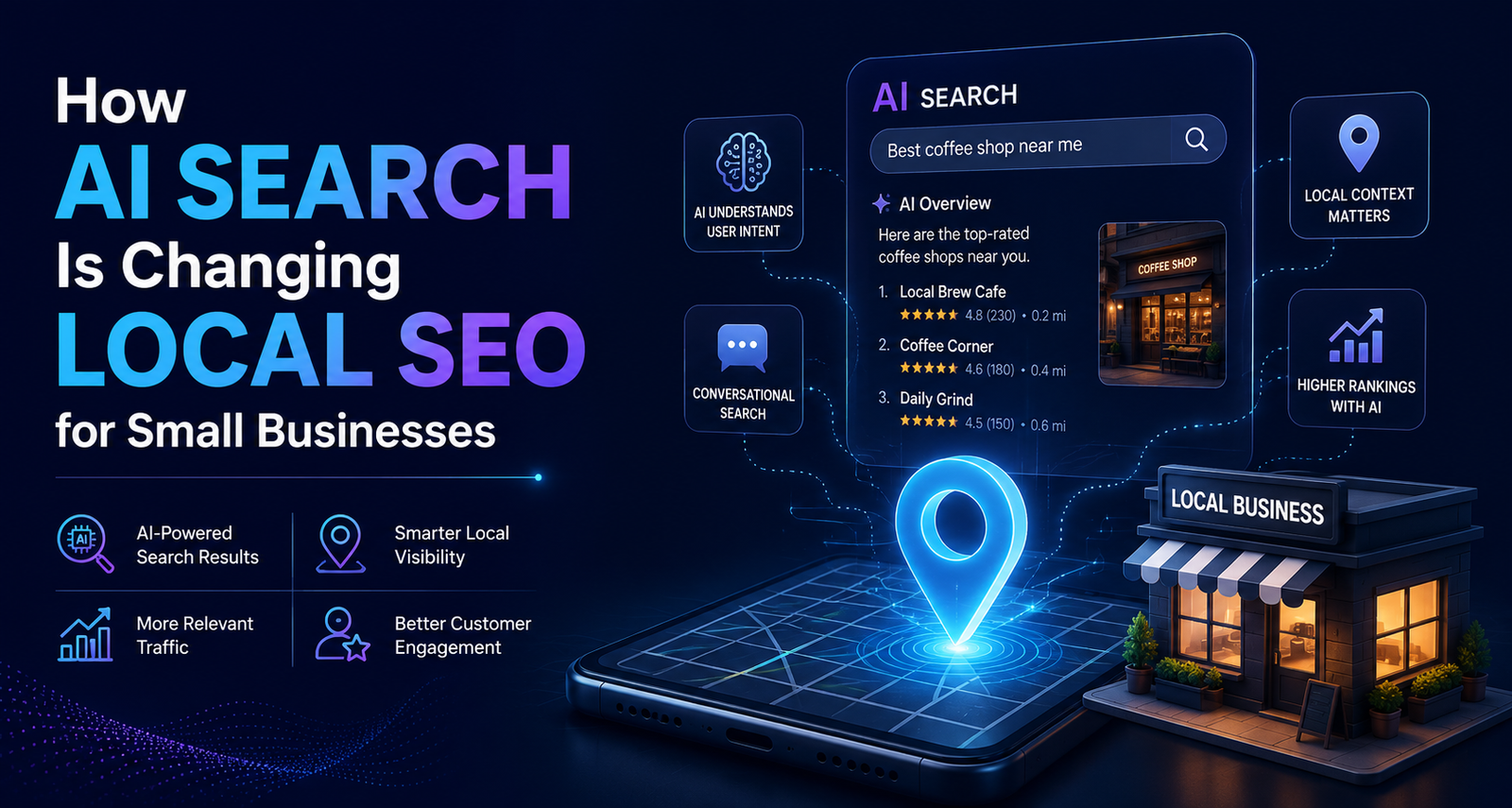
If you own a small business in the United States, you’ve probably noticed something different about how customers find you online. A search for “plumber near me” or “best dentist in [city]” no longer just returns a list of blue links. Instead, it often surfaces an AI-generated summary that answers the question directly, sometimes without the searcher ever clicking through to a website. This shift is one of the biggest changes to hit local search in years, and it’s rewriting the rules of Local SEO for Small Businesses. Understanding how AI search works, and how to adapt your strategy, is quickly becoming the difference between businesses that get found and businesses that get left behind. What Is AI Search, and Why Does It Matter for Local Businesses? AI search refers to tools like Google AI Overviews, ChatGPT, Gemini, and Perplexity that generate direct, conversational answers to search queries instead of simply listing websites. Rather than sending users to your site to find your hours, services, or reviews, these tools now summarize that information right in the results. For local businesses, this matters because “near me” searches make up a huge share of local intent, and AI is increasingly the layer standing between your business and the customer. When someone asks an AI assistant “who offers the best HVAC repair near me,” the AI pulls its answer from a combination of your Google Business Profile, third-party directories, reviews, and structured content on your website. If that information is thin, outdated, or inconsistent, your business simply won’t make the list. The Big Shift: From Rankings to Recommendations Traditional SEO was built around ranking a webpage as high as possible in a list of search results. AI search operates differently. It’s less about ranking and more about being selected as a trustworthy answer. This is often referred to as Answer Engine Optimization (AEO), and it works alongside traditional local SEO rather than replacing it. Instead of optimizing purely for keywords, AI systems look for clear, structured, and easily verifiable information: your business name, address, and phone number (NAP), your services, your hours, and what real customers say about you. Businesses that make this information easy for AI to find and trust are far more likely to be cited in AI-generated answers, map packs, and voice search results. Why Small Businesses Can’t Afford to Ignore This Zero-click searches, where a user gets their answer without visiting a website, now account for a majority of mobile searches. That sounds alarming for traffic, but there’s a silver lining: customers who do click through after seeing an AI summary tend to be further along in their decision-making process. They already know your services, your reputation, and your location. That means higher-intent leads, even if raw click volume declines. In other words, visibility inside AI search results isn’t optional anymore. It’s becoming the new front door for local discovery, and small businesses that adapt early will have a real competitive advantage over those still relying solely on traditional ranking tactics. How to Optimize Local SEO for Small Businesses in the AI Search Era 1. Keep Your Google Business Profile Accurate and Active Your Google Business Profile is one of the most heavily weighted sources AI search tools pull from. Make sure your name, address, phone number, hours, categories, and service areas are complete and consistent. Post updates regularly, add photos, and respond to every review. An active, accurate profile signals legitimacy to both AI systems and human customers. 2. Prioritize Consistent NAP Data Everywhere AI search tools cross-check your business information across multiple directories, including Yelp, the Better Business Bureau, and industry-specific listings. If your name, address, or phone number doesn’t match across platforms, it creates doubt in the eyes of AI systems, and doubt means you’re less likely to be recommended. Audit your listings regularly and fix any inconsistencies. 3. Build a Strong, Recent Review Profile Reviews have always mattered for local SEO, but they matter even more now. Research shows AI tools tend to favor businesses with consistently high ratings and active review responses. Encourage happy customers to leave reviews, and respond to all of them, positive or negative, promptly and professionally. Review velocity and response rate are becoming real ranking signals in AI-driven local search. 4. Write Content That Directly Answers Local Questions AI systems favor content that reads like a clear, natural answer to a real question. Instead of writing generic service pages, structure content around the actual questions your customers ask: “How much does a water heater repair cost in [city]?” or “What should I look for in a local dentist?” Clear, conversational, well-organized content gives AI tools an easy answer to extract and cite. 5. Create Hyperlocal, Community-Focused Content Going beyond basic service pages helps establish your business as a genuine local authority. Blog about local events, neighborhood guides, or industry-specific advice tied to your city or region. This kind of hyperlocal content is difficult for larger competitors to replicate and gives AI search tools more localized, relevant signals to associate with your business. 6. Use Structured Data and Clear Site Organization Structured data (schema markup) helps AI systems and search engines understand exactly what your business offers, where you’re located, and what makes you credible. Pair this with a clean site structure, fast load times, and mobile-friendly design, since AI tools favor sites that are easy to crawl and easy to trust. 7. Monitor Your Visibility Across AI Platforms Local SEO for small businesses now means tracking more than just Google rankings. Periodically search for your own business (and competitors) using tools like ChatGPT, Gemini, and Perplexity to see if and how you’re being mentioned. This kind of visibility check helps you catch gaps before they cost you customers. The Bottom Line AI search isn’t replacing local SEO, but it is fundamentally changing what “ranking well” looks like. For small businesses across the USA, success now depends on accurate business data, strong reviews, and content that speaks clearly and directly
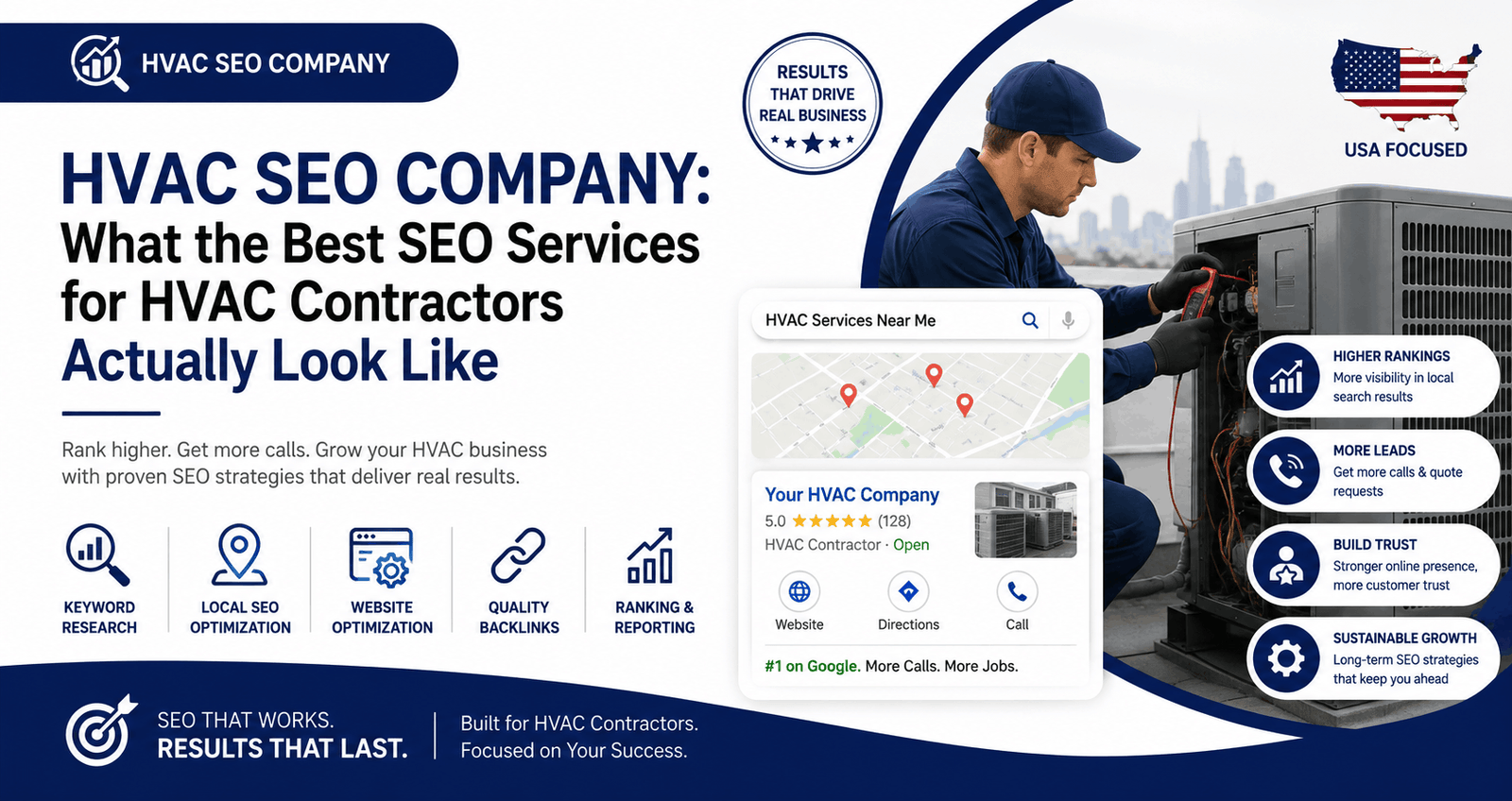
HVAC SEO Company: What the Best SEO Services for HVAC Contractors Actually Look
Every HVAC business owner eventually hits the same wall: your trucks are booked, your reviews are solid, your techs do great work – but your website is buried on page two while a competitor with a worse install crew ranks above you. That gap rarely comes down to service quality. It comes down to search visibility, and that’s exactly what a dedicated HVAC SEO company is built to fix. The problem is that “SEO for HVAC contractors” has become a crowded label. Dozens of agencies claim to specialize in home-service marketing, but many are running the same generic playbook they’d use for a law firm or a restaurant. If you’re trying to figure out what separates a real HVAC SEO company from a generic marketing shop wearing an HVAC-flavored sales page, this guide walks through exactly that – and what to look for before you sign a contract. Why HVAC Contractors Need an Industry-Specific SEO Company Generic SEO agencies treat every business the same – restaurants, law firms, HVAC companies- all run through the same template, the same keyword tools, the same generic blog calendar. That approach falls apart fast in HVAC, for a few specific reasons. Search intent is split between emergency and research modes. A furnace-down search at midnight needs a completely different page than someone comparing heat pump brands over a two-week research window. The first searcher wants a phone number and a same-day appointment above the fold. The second wants pricing ranges, financing options, and comparison content. An agency without HVAC experience often collapses both into the same generic “Contact Us” page and wonders why conversion rates stay flat. Local competition is fierce and hyper-specific. Ranking in the local three-pack for “AC repair near me” requires deep, ongoing Google Business Profile management – categories, service areas, Q&A sections, photo uploads, and a steady cadence of new reviews. Most generalist agencies treat GBP as a one-time setup task rather than an ongoing local SEO lever, which is a mistake in a category this competitive. Seasonality drives almost everything. Search volume for cooling-related terms can double or triple heading into summer, then flip hard toward heating terms by early fall. A campaign built without that seasonal curve in mind ends up publishing AC content in November and furnace content in June – a full season behind demand. HVAC SEO companies that know the industry plan content and paid spend around these cycles months in advance, not reactively. A true HVAC SEO company builds its entire strategy – content calendar, keyword targeting, technical SEO, and local optimization – around these industry-specific patterns rather than a one-size-fits-all local business template. What SEO Services for HVAC Contractors Should Include If you’re evaluating an SEO agency for your HVAC business, here’s the baseline of what a comprehensive service package should realistically cover. Anything missing from this list is a gap worth asking about directly. 1. Local SEO & Google Business Profile Management: Complete, verified, and actively managed GBP listings with regular review generation campaigns, accurate service categories for every service you offer, location-specific posts, and ongoing photo and Q&A updates. This should be treated as a living asset, not a set-and-forget listing. 2. Service + City Page Architecture: Dedicated landing pages for every core service – repair, installation, maintenance, duct cleaning, heat pump service – crossed with every city or neighborhood you actually serve. A single generic “service area” page trying to rank for a dozen cities at once almost never performs as well as individually optimized pages built around each location’s actual search behavior. 3. Keyword-Targeted Content Blog and service content built around real search intent, not just search volume. That means emergency terms (“no heat emergency service”), installation research terms (“cost to replace ac unit”), seasonal maintenance terms (“fall furnace tune up”), and local “near me” searches – all mapped to the pages best suited to capture each type of intent. 4. Technical SEO Site speed optimization, mobile performance tuning, schema markup (LocalBusiness, FAQPage, Service schema), clean URL structure, and solid internal linking. Technical performance matters more for HVAC than for most industries, because urgent searchers on a slow-loading site abandon almost instantly and call the next name in the list. 5. Review & Reputation Management A steady, keyword-informed review acquisition process. Review volume and recency are widely recognized as major local ranking factors, and a strong review profile also directly increases conversion rate once a searcher lands on your listing. 6. Reporting Tied to Booked Jobs, Not Just Traffic The best SEO agency for HVAC companies reports on calls, form fills, and booked appointments – not just impressions, sessions, and keyword rankings. Rankings are a means to an end; the number that actually matters is jobs on the schedule. Red Flags When Choosing an HVAC SEO Company Not every agency pitching “HVAC SEO services” is equipped to deliver them. A few warning signs worth watching for: What to Ask Before You Sign A short list of direct questions tends to separate a genuine HVAC SEO company from a generalist agency fast: An agency that answers these clearly and specifically, with real examples, is far more likely to deliver results than one that leans on generic marketing language and stock case studies. How Much Do SEO Services for HVAC Contractors Typically Cost? Pricing for HVAC SEO services varies widely depending on market size, competition, and how much of the package above an agency actually delivers. As a general guide: Be cautious of pricing that seems unusually low relative to the scope promised – a package priced well below market rate is often a sign that GBP management, content production, or technical work will be minimal or templated rather than genuinely customized to your service area. The more useful question isn’t “what’s the cheapest package,” but “what’s the cost per booked job once this campaign is running at full strength” – which is exactly why reporting tied to calls and appointments, not just traffic, matters so much when comparing agencies.
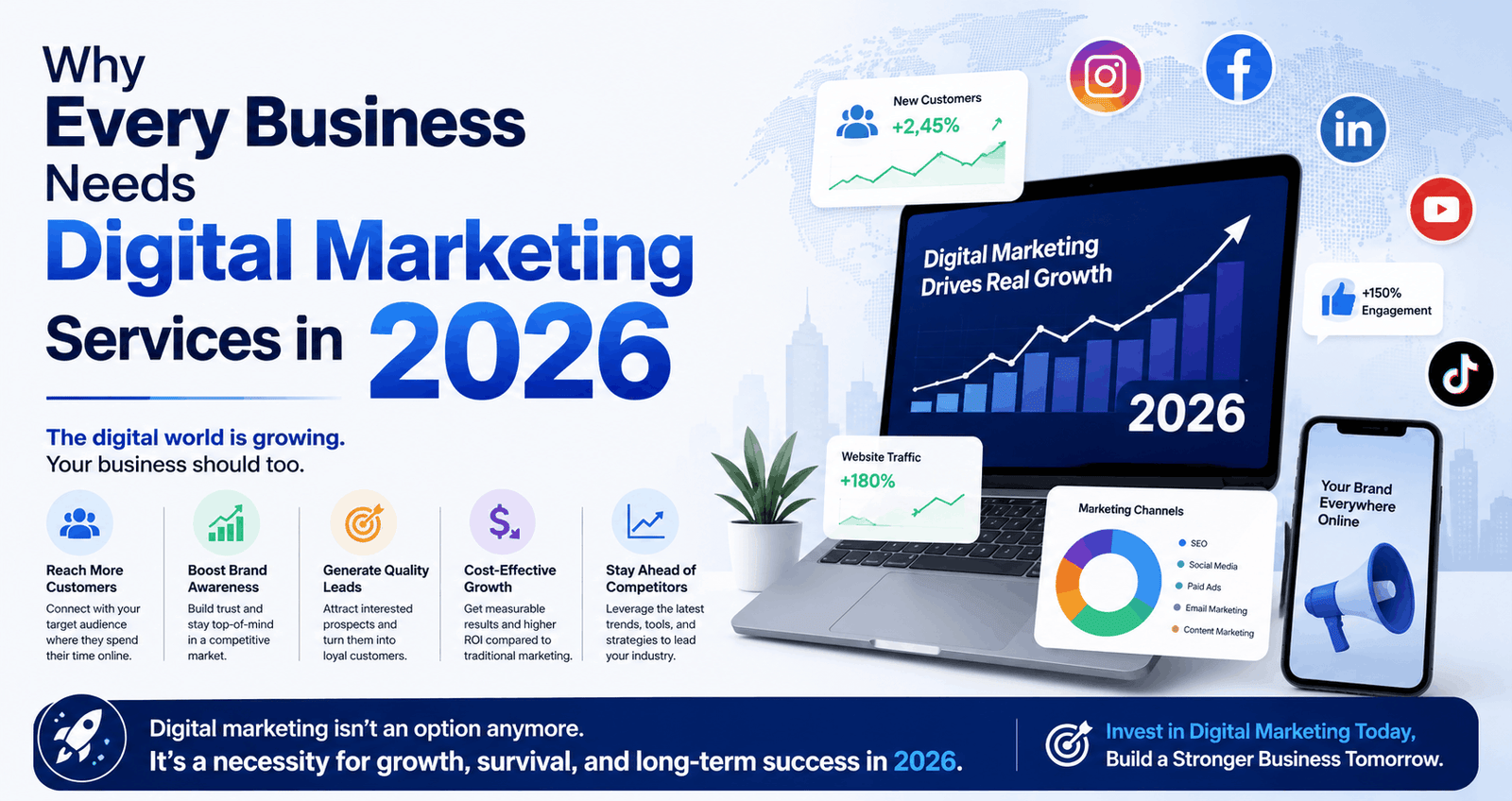
Why Every Business Needs Digital Marketing Services in 2026
The Way People Find Businesses Has Permanently Changed A decade ago, a customer with a leaky faucet might flip open a phone book or ask a neighbor for a recommendation. Today, that same customer opens Google, types “plumber near me,” and calls one of the first three results they see. If your business isn’t optimized to appear in that search, you don’t lose the sale – you never even entered the conversation. This shift applies across nearly every industry: dental practices, HVAC companies, roofers, retailers, law firms, restaurants, and B2B service providers. The common thread is that visibility now happens online first. Digital marketing services exist to make sure your business shows up at that critical moment of intent, not just for big national brands, but for local businesses competing in their own backyard. Digital Marketing Services Level the Playing Field One of the most overlooked benefits of digital marketing is that it doesn’t require a massive budget to compete. A well-optimized website, a strong Google Business Profile, and a focused pay-per-click campaign can put a small, local business directly in front of the same customers a much larger competitor is chasing – often at a fraction of the cost of traditional advertising. Where a billboard or a radio spot reaches everyone, whether they’re interested or not, digital marketing services let you target specific people: those searching for your exact service, in your exact service area, at the exact moment they’re ready to buy. That precision is what makes digital marketing more cost-effective than most traditional advertising, especially for small and mid-sized businesses with limited marketing budgets. What “Digital Marketing Services” Actually Includes The phrase gets used loosely, so it helps to break down what comprehensive digital marketing services typically cover: Search Engine Optimization (SEO): SEO is the foundation of long-term visibility. It involves optimizing your website’s structure, content, and technical performance so search engines rank you higher for the terms your customers are actually searching. Unlike paid ads, SEO builds an asset that keeps generating traffic over time rather than disappearing the moment you stop paying for clicks. Pay-Per-Click Advertising (PPC): PPC campaigns put your business at the top of search results immediately, while your SEO efforts build momentum in the background. A well-managed PPC strategy targets high-intent keywords, tracks return on ad spend, and adjusts in real time based on what’s actually converting. Social Media Management: Social platforms aren’t just for brand awareness anymore – they’re discovery engines, customer service channels, and trust-building tools. Consistent, strategic social media management helps businesses stay relevant in front of an audience that increasingly expects brands to show up where they already spend their time. Web Design and Development: Your website is often the first real impression a potential customer has of your business. A slow, outdated, or hard-to-navigate site undoes the work of every other marketing channel. Modern digital marketing services include building websites that are fast, mobile-friendly, and designed to convert visitors into leads. Content Marketing: Blog posts, service pages, guides, and other content do double duty: they help search engines understand what your business does, and they help potential customers understand why they should choose you. Strong content marketing builds authority and answers the questions your customers are already asking. Together, these services don’t operate in isolation – they reinforce each other. SEO drives organic traffic to a website that content marketing has made informative and PPC has made immediately visible, while social media keeps the relationship going after that first visit. Why DIY Marketing Usually Falls Short Many business owners start by handling marketing themselves, and that’s a reasonable instinct – nobody knows the business better than the person running it. But digital marketing has become genuinely technical. Search engine algorithms change constantly, ad platforms get more complex every year, and what worked twelve months ago may actively hurt performance today. Running a business and running a full digital marketing strategy are both full-time jobs. Trying to do both usually means one of them suffers, and it’s rarely the day-to-day operations that get neglected. This is the core reason businesses turn to digital marketing services: not because they can’t understand marketing, but because they don’t have the bandwidth to execute it consistently and competently while also running everything else. The Cost of Doing Nothing It’s tempting to think of digital marketing as optional, something to revisit “when business picks up.” But the businesses that wait are usually the ones losing ground to competitors who didn’t wait. Every day without proper SEO is another day competitors rank above you. Every month without a content strategy is missed opportunities to answer customer questions and build trust. Every outdated website is a steady trickle of visitors who land on the page and immediately leave. The cost of inaction doesn’t show up as a line item – it shows up as quieter phones, fewer form submissions, and a shrinking share of a market that’s actively moving online. In competitive local industries, that gap compounds. The business that invests in digital marketing services this year isn’t just gaining customers today; it’s building a lead that gets harder for competitors to close. What 2026 Specifically Changes A few shifts make this year particularly important for businesses still on the fence: None of this means starting from scratch is too late – it means the businesses that act now have a real opportunity to build an advantage before the gap widens further. Choosing the Right Digital Marketing Partner Not all digital marketing services are created equal, and the difference between a strategic partner and a vendor selling generic packages can make or break your results. When evaluating who to work with, look for: The right partner doesn’t just execute tasks; they understand how all these channels work together to move your specific business forward. The Bottom Line Digital marketing services aren’t a luxury reserved for large corporations with unlimited budgets. They’re the modern equivalent of being listed in the right place, recommended by the
The Future of SMO: How AI and Social SEO Are Transforming Google Rankings
Search is no longer just about blue links and keyword density. In 2026, Google’s AI Overviews, ChatGPT, Perplexity, and other generative engines are reshaping how people discover businesses online – and social media has quietly become one of the strongest signals feeding that discovery. For business owners searching for SMO Services in USA, this shift isn’t a distant trend anymore. It’s the new baseline for ranking, visibility, and trust. At Apex SEO Solutions, we’ve watched this transformation unfold in real time across our client base – HVAC contractors, dental practices, plumbers, roofers, and other service-based businesses that depend on local visibility to win customers. This article breaks down exactly what’s changing, why social media optimization (SMO) now sits at the center of modern SEO, and how the right SMO Package can help your brand stay visible no matter how search evolves. What Is SMO, and Why Does It Matter More Than Ever? Social Media Optimization (SMO) is the practice of optimizing your social profiles, content, and engagement strategy to improve brand visibility, drive traffic, and build the kind of authority signals search engines now reward. Unlike traditional SEO, which focuses heavily on your website, SMO extends your visibility across platforms like Instagram, Facebook, LinkedIn, YouTube, and TikTok. For years, social media and SEO were treated as separate disciplines run by separate teams. That separation is dissolving fast. Industry analysts now describe the discipline as “Search Everywhere Optimization” – a recognition that visibility across Google, AI platforms, YouTube, and social channels is what actually drives discovery today, not ranking position on a single search engine alone. How AI Is Rewriting the Rules of Google Rankings 1. Zero-Click Searches Are the New Normal Nearly 60% of Google searches now end without a click, as AI Overviews answer questions directly inside the search results page. For informational queries, this means fewer visitors land on your website – even if you’re ranking well. The takeaway for service businesses isn’t to panic, but to adapt: commercial and transactional searches (someone looking for “HVAC repair near me” or “dentist Sheridan WY”) still drive strong click-through, because people want to compare, call, and book – not read a generic AI summary. This is exactly why local service businesses can’t abandon SEO. It just means SEO now needs reinforcement from every other channel that builds trust, including social media. 2. Brand Signals Are Becoming Core Ranking Factors AI systems no longer evaluate your website in isolation. They aggregate everything the internet says about your brand – reviews, social media activity, forum mentions, and PR coverage – and use that composite picture to decide whether you’re worth recommending. Websites with strong, consistent brand signals across multiple platforms are proving far more resistant to Google’s frequent algorithm updates than sites relying purely on technical SEO tactics. In practice, this means your Instagram presence, your Google Business Profile reviews, and your LinkedIn activity are no longer “extra” marketing – they’re part of your ranking infrastructure. 3. E-E-A-T Now Requires Cross-Channel Proof Experience, Expertise, Authoritativeness, and Trustworthiness (E-E-A-T) have been part of Google’s quality guidelines for years, but in 2026, they’re becoming the dominant filter AI systems use to decide what to cite and recommend. The catch is that E-E-A-T can’t be faked with a few well-written paragraphs. It has to be demonstrated – through real customer reviews, authentic social proof, video testimonials, and a visible, active presence where your customers already spend time. Industry surveys show that nearly every SEO professional now agrees trust signals will matter more this year than ever before, yet most businesses still aren’t actively building them. That gap is exactly where a well-executed SMO strategy creates a competitive edge. 4. Video and Visual Content Are Search Channels in Their Own Right Short-form video on TikTok, Instagram Reels, and YouTube Shorts isn’t just for brand awareness anymore – it’s increasingly indexed, transcribed, and surfaced inside AI-generated answers and traditional search results alike. A roofing company that posts before-and-after job videos, or a dental practice sharing patient testimonials, is feeding exactly the kind of authentic, human content that AI systems and search engines are designed to favor over generic, AI-written filler. 5. Local and Review-Driven Signals Are Compounding in Value For service-based businesses – the core of Apex SEO Solutions’ client base – local signals matter more than almost anything else. Consistent business information across directories, an actively managed Google Business Profile, and a steady stream of authentic customer reviews all feed into the same trust evaluation that AI systems use when deciding which businesses to surface for “near me” searches. Why Social SEO and Traditional SEO Now Have to Work Together The old playbook treated SEO as a technical, on-site exercise: keywords, backlinks, page speed, schema markup. Those fundamentals still matter – they haven’t disappeared. But on their own, they’re no longer enough to differentiate one HVAC company from another in a competitive local market. What’s changed is the addition of a second, equally important layer: visibility and trust signals generated off-site, primarily through social channels. Search engines and AI models increasingly treat strong social presence as a proxy for legitimacy. A dental practice with hundreds of authentic Google and Facebook reviews, active social profiles, and patient-shared content sends a far stronger trust signal than one with a perfectly optimized website and no social footprint at all. This is the foundation of what we mean by Social SEO: using social media not just for engagement, but as a deliberate input into your overall search visibility strategy. What a Strong SMO Package Should Include in 2026 If you’re evaluating SMO Services in USA for your business, here’s what an effective, modern SMO Package needs to cover: Profile and Brand Consistency Your business name, address, phone number, and branding need to be consistent across every platform – social profiles, directories, and your Google Business Profile. Inconsistency erodes the trust signals AI systems rely on. Content Strategy Aligned with Search Intent: Posts shouldn’t just fill a calendar. They should
Google AI & LLM SEO Updates 2026: What Businesses Need to Know
If you’ve noticed your organic traffic behaving strangely in 2026 – impressions climbing while clicks fall, or rankings holding steady but leads drying up – you’re not imagining it. Google’s AI and LLM updates have fundamentally rewritten the rules of search visibility. The question isn’t whether SEO has changed. It’s whether your strategy has caught up. This blog breaks down exactly what’s happening, what the data shows, and what you need to do to stay competitive. The AI Takeover of Google Search Search in 2026 looks almost nothing like it did two years ago. Google has effectively merged its AI Overviews, Gemini, and classic search into one unified experience – powered globally by the Gemini 3.5 Flash model that rolled out alongside the May 2026 Core Update. AI Overviews now appear on approximately 47–64% of all search queries across desktop and mobile. In high-intent verticals like health, finance, technology, and education, that number climbs above 70%. That means more than half of all searches now encounter an AI-generated summary before they ever see a traditional organic result. The impact on click-through rates has been severe. Studies from Semrush and Ahrefs confirm a 30–50% average reduction in CTR on queries where AI Overviews appear. Position one organic CTR on those queries has dropped from 27% to as low as 11%, according to SISTRIX data from March 2026. Here’s the kicker: zero-click searches now account for 58.5% of all US Google searches (SparkToro, 2026). More than half of all search sessions end without a single outbound click. If your SEO strategy was built on traffic volume alone, this is the reality check you needed. Ranking #1 No Longer Guarantees You’re in the AI Overview This is perhaps the most disorienting shift for SEO professionals in 2026. Historically, ranking in the top three meant visibility. That’s no longer the case. The Gemini-3 rollout in January 2026 appears to have permanently decoupled traditional ranking from AI Overview inclusion. The overlap between organic top-10 results and AI Overview citations has dropped from around 76% in mid-2025 to somewhere between 17% and 54% in early 2026, depending on the study. Ranking #1 no longer guarantees you’ll be cited in the AI summary above it. AI Overviews now pull from an average of 13.34 sources per response – up from roughly 6.82 in 2024. This wider citation pool means the game has changed: it’s no longer enough to rank. You need to be the kind of source that AI systems trust enough to cite. What Google’s Major 2026 Updates Actually Mean March 2026 Core Update: Domain Authority Over Page Optimization The March 2026 Core Update sent a clear structural signal: domain-level authority is now outweighing page-level optimization. Sites that publish comprehensively within a single subject area – covering every angle, every sub-topic, in multiple content formats – significantly outperformed broad sites that touched many topics at shallow depth. The update also re-weighted what’s known as “Information Gain” – a ranking signal measuring how much genuinely new knowledge a piece of content adds relative to what already exists. The question Google is now effectively asking: If your content disappeared from the internet tomorrow, would anyone lose access to information they couldn’t find somewhere else? If the answer is no, your content is at risk. May 2026 Core Update: The End of Low-Effort Content Launching alongside Google I/O announcements, the May 2026 Broad Core Update took an aggressive stance against what Google calls “commodity content” – generic, widely available information that an AI could generate itself. Google’s own Search Liaison Danny Sullivan has warned that content which is interchangeable or easily replicated will not perform in this new environment. The update specifically targets: If your agency or marketing team has been scaling content output without scaling content quality, this update is directly aimed at you. Google I/O 2026: AEO and GEO Are Now Just SEO Perhaps the most clarifying statement from Google I/O 2026 came from Google’s own May 2026 guide, which confirmed: there is no separate strategy for AI search. Answer Engine Optimization (AEO) and Generative Engine Optimization (GEO) are simply foundational SEO applied to an AI surface. The New Visibility Currency: AI Citations Being cited inside an AI Overview is now commercially more valuable than holding the top organic position below it. Data published by Digital Applied in March 2026 shows that brands cited inside AI Overviews earn 35% more organic clicks and 91% more paid clicks compared to non-cited competitors on the same queries. That gap is the most important metric in search right now – and most businesses aren’t measuring it. A Search Engine Journal study analyzing 11 sites affected by Google’s January 2026 update found that sites that lost organic traffic also saw an average 22% decline in AI search citations across all AI models. Traditional SEO and LLM visibility are correlated. You cannot build one without the other. What Actually Gets You Cited by AI and LLMs in 2026 1. Original, Expert-Attributed Content AI systems – whether Google’s, ChatGPT’s, or Perplexity’s – share a consistent citation profile: content that is original, expert-attributed, and topically authoritative. Generic summaries that AI can generate itself carry zero citation value. Only content reflecting genuine expertise, original research, or first-hand experience earns inclusion. Use AI as a drafting tool, not a publishing tool. Content assisted by AI but substantially edited by a named human expert, grounded in original perspective, performs well under Google’s E-E-A-T standards. 2. Content Depth and Structure Articles over 2,900 words average 5.1 AI citations, while those under 800 words get 3.2, according to SE Ranking data. Pages using 120–180 words between headings receive 70% more ChatGPT citations than pages with sections under 50 words. Question-based headings and FAQ sections also meaningfully boost AI citation rates. 3. Structured Data – Now Table Stakes Structured data is no longer optional for AI Overview visibility. Essential schema types include Article Schema with author, datePublished, and dateModified markup, FAQ Schema for question-answer content, and nested Schema types
SEO vs Google Ads: Pros, Cons, Cost & ROI Comparison
There’s no universal answer when it comes to SEO vs Google Ads. SEO (Search Engine Optimization) helps build long-term organic traffic, trust, and strong organic search rankings, but it usually takes 3–6 months to show real results. Google Ads, on the other hand, delivers immediate visibility and faster leads through paid search advertising, but the traffic stops the moment you stop paying. For most businesses, the smartest approach is to combine both – using Google Ads for quick wins while building sustainable organic growth through SEO for long-term ROI. What is SEO? (Search Engine Optimization) SEO is the process of enhancing your website’s performance to appear higher on search engine result pages (SERP) without the expense of advertisements. If someone is searching for “plumber nearby my home” or “best CRM software”,” SEO helps your website be found in organic results, which is in contrast to the paid advertisements. Search Engine Optimization includes optimization of content and website optimization, as well as technological fixes, linking building, and search engine optimization. The benefit of SEO is the fact that, once you have a rank, you will receive organic traffic on a continuous basis without the need to pay per click. It requires constant effort and perseverance to keep positions. What is Google Ads? (Paid Search Advertising / PPC) Google Ads is Google’s pay-per-click (PPC) advertising platform that lets businesses bid on keywords in order to place advertisements in the uppermost position of results for search. Pay only when someone clicks on your advertisement and it is the only one that’s performance-based. The key elements include keyword targeting and bid management and ad creation and landing pages, as well as budget control. Google Ads offers immediate visibility–your advert can be seen on the first page within hours of its launch. This means that PPC is the ideal choice for promotions that are time-sensitive or companies that require leads quickly. SEO vs Google Ads – Key Differences Factor SEO Google Ads Cost Monthly service fees; no per-click costs Monthly budget for advertising plus management costs Speed Minimum of 3-6 months In the immediate (hours from hours to days) Long-term ROI Compounds are formed over time. Stops at the time budget expires Trust Greater trust among users Trust is lower (labeled by ads) Best For Long-term growth Quick wins, adversity Pros and Cons of SEO Pros of SEO Cost-effectiveness as time passes -After you have ranked organically, it’s essentially free. You don’t have to pay for each visit, which makes the ROI of your investment appealing. Creates trust and credibility -The users prefer organic results over advertisements. The fact that you are on the first page indicates credibility and authority within your field. A reliable source of traffic- Good rankings could last for months or even years with regular maintenance. The traffic won’t stop after you stop a campaign. Higher rates of click-through -Organic listings usually receive more clicks than ads that are paid, particularly for informational queries. The content is compounded in duration – The more time you invest in SEO the more visible your website grows. Old content continues attracting visitors. Cons of SEO Results are slow. Expect to wait three to six months before seeing substantial traffic. Websites that are new may take longer to establish an authority. requires ongoing effort –The algorithms used to search for content are constantly changing. Continuous content creation as well as technical updates and monitoring. Competitive in certain niches Highly competitive industries require significant investment to compete with established players. No guarantees of rankings- Contrary to paid advertisements it isn’t possible to purchase the highest ranking. Rankings vary according to a myriad of different factors. Algorithm dependence on HTML0 algorithm Google updates could affect rankings quickly, which requires immediate adjustments. Pros and Cons of Google Ads Pros of Google Ads Instant visibility- The ads will be displayed within hours. This is ideal for businesses who require leads now and not in six months from today. Targeting precisely- targets the device, location and time of day demographics, or even keywords from competitors. Stable and predictable- If you discover profitable campaigns, you are able to expand your reach by increasing budget. Data and testing- You can quickly test headlines as well as offers and landing pages. Data helps enhance both organic and paid strategies. Budget management- Control budgets by setting daily limits. Stop or alter campaigns at any time without commitments to long-term. Retargeting features- Retarget those who visited your website but didn’t make the switch the first time around. Cons of Google Ads Ongoing cost- Traffic ceases once you’ve stopped paying. There’s no future benefit. Rising competition – Popular keywords get expensive. Some industries experience extremely high cost per click, which can cause budget pressure. Fraudulent clicks and waste spending The reality is that not every click is converted. Budgets are able to disappear rapidly without the proper optimization. Lower levels of trust Many people avoid advertisements completely, preferring natural results. Requires expert knowledge Campaigns that are poorly managed will burn through money quickly. Effective PPC requires expertise in bidding, copywriting and optimization of conversion. Affects the effectiveness of your ads As time passes your intended audience is exposed to your advertisements repeatedly, which reduces the effectiveness. SEO vs Google Ads Cost Comparison (realistic Pricing) SEO Monthly Cost 1. SEO vs. Google Ads: Realistic Cost Comparison Feature SEO (The Long Game) Google Ads (The Quick Tap) Average Monthly Investment moderate, consistent monthly investment Higher, variable spend based on competition Cost Basis Retainer or Project Fee Pay-Per-Click (CPC) Speed to Results Medium to long term (several months) very fast (often within days) Sustainability Traffic lasts after you stop paying Traffic stops the second you stop Primary Goal Authority & Brand Trust Immediate Leads & Sales Typical CPC/Cost No direct cost per click once ranking Cost per click varies by industry and competition SEO vs Google Ads ROI Comparison (What Gives Better Return?) SEO generally has a greater ROI over the long term since the traffic won’t stop
Local SEO for Roofing Companies: How to Outrank Your Competitors
If a roof of a homeowner starts to leak at 2 am during a storm, don’t scour the Yellow Pages. They’re using their smartphones to search to find “emergency roof repair in my area” as well as “roofing contractors near me.” If your roofing business does not show up in the initial results, you’re risking high-value jobs to competitors that have developed effective Local SEO plans. The competition is intense. The majority of homeowners pick the most popular three results when looking for a roofer on Google Maps or local search results. The art of Local SEO for roofing companies is the difference between having a full-time schedule and watching your competitors seize your lead. This complete guide will teach you how to be the top local search result to generate steady leads and generate an unstoppable flow of top-quality roofing work with proven SEO strategies. What is Local SEO for Roofing Companies? This means enhancing your online website to be found by potential customers searching for roofing services within your particular location. Contrary to traditional SEO which has a national focus, regional SEO targeting roofing businesses can connect you to homeowners and property managers who are looking for roofing solutions in the vicinity. How Local Search Results Work When a user searches for “roofing firm close to me” as well as “roof repair service in [city,” Google evaluates hundreds of elements to determine their rankings. Results from searches typically contain three major sections: Local Pack Local Pack displays three roofing firms including their addresses, reviews and contact details. This is the prime real estate source for the majority of quotes and calls. Local Organic Results (LOR) are the traditional results that are optimized to be local-focused, and include roofing companies that have a strong web authoritativeness and credible content. Google Maps Results show an extended list of roofing companies which are ranked by relevancy as well as distance and prominence by clicking “more locations.” Why This Matters? Research suggests the 97% rate of users look online for local services and 88 percent of mobile searches for local businesses will result in an appointment or phone call in less than 24 hours. For roofing firms, these figures are real homeowners who have urgent requirements and buying power. Why Roofing Companies Need Local SEO? The roofing industry is unique in its features which ensure the local SEO of roofing companies essential for their survival and growth. Emergency-Driven Search Behavior In contrast to planned home improvement projects, many roofing problems arise abruptly. Unexpected leaks, storms, and structural issues can create circumstances where homeowners require urgent assistance. If someone is searching to find “emergency repairs to the roof” late at night, they’re not buying, but rather they’re hiring the first expert they can find. The local SEO strategy for roofing companies will ensure your presence during these crucial decisions in which prospects are the most likely to convert into paying customers. High-Value Local Customers The roofing projects are a big investment. If it’s a minor fix or a complete roof replacement homeowners are determined to solve their issues quickly. They’re not casual visitors, they’re professional prospects with genuine requirements and budgets. Each roofing lead that comes from local searches typically is 10-50 percent the worth of lead generated by other sectors. A single lead can bring up to $50,000 in revenue which makes each rank position extremely important. Mobile-First Decision Making The majority of roof-related searches are conducted through mobile devices. Homeowners who are standing in their flooded attic or gazing at water-stained ceilings instantly take their smartphones. They’re in need of immediate information: the location of your home and availability, reviews telephone number, as well as the service areas. Businesses that do not have mobile-friendly websites or robust Google Business Profiles can lose customers to rivals that offer superior mobile experience. Implementing a successful local SEO strategy for roofing firms means prioritizing mobile optimization. Essential Local SEO Services for Roofing Companies Effective roofing SEO incorporates a number of factors that are strategically placed to improve your local exposure. Local SEO for roofing companies techniques are the basis of digital dominance. 1. Google Business Profile Optimization The Google Business Profile (formerly Google My Business) is the base of your local roofing success. This tool is free and controls the way your business appears on Google Maps and local search results. The most important optimization steps are: Profiles that are optimized for companies get 7 times more clicks, and five times more web page visits than those with profiles that are not optimized. 2. Website Optimization Your website is your online storefront. It must be optimized for humans as well as search engines. The technical aspects include: speedy loading speed, mobile responsiveness and secured HTTPS protocols as well as a clean website architecture. Google penalizes slow, inefficient websites, regardless of quality of content. On-page SEO requires specific landing pages that are local to each area of service specific to the service area, pages that focus on phrases like “residential roof” and “storm repair of damage,” and clear calls to action that direct users to contact us for estimates. Conversion-focused designs include call numbers that are prominent, click-to-call buttons, a straightforward form for requesting quotes, trust signals such as certificates and warranties, as well as an impressive before-and-after gallery of projects. 3. Local Citation Building Citations are online citations of your roofing company’s name, address, and telephone number on directories, websites for industry, and local business websites. Regular citations on trusted websites improve local rankings and aid in helping prospective customers find your business via various channels. The top priority platforms are Angi, HomeAdvisor, Yelp, BBB, Chamber of Commerce directories, as well as specific sites for industries like The National Roofing Contractors Association. 4. Review Management and Reputation Building Online reviews directly impact the rankings of search engines as well as conversion rate. Reviews can be used as powerful social proof that can influence hiring choices. The majority of homeowners look up online reviews
HVAC SEO in USA & Ranking Factors for 2026 Strategies
If you’re the owner of an HVAC business in 2026, then you’re aware there will be a lot of competition. Homeowners looking for services to heat and cool their homes are more spoiled than ever and they typically start their search with Google. The question is whether they come across your company or your competition’s? The answer is based on one crucial element – HVAC SEO in USA. Search engine optimization has advanced significantly, and HVAC companies that do not change are in danger of losing out on local results on search engines. In 2026, being ranked on Google isn’t only about having a website. It is about the ability to master local HVAC SEO optimization, preparing for AI-powered search, establishing trust signals and writing content that proves your knowledge. This guide will break down the most important HVAC SEO rankings factors to be considered in 2026. We will show you how to utilize SEO to implement HVAC strategy to be a leader in any local competition, earn more leads and increase your profits. What Is HVAC SEO and Why It Matters in 2026 While focusing on HVAC-specific factors is key, you can also explore our broader Local SEO guide for home service professionals to see how these strategies apply across all trade industries. HVAC SEO is the method of optimizing your heating and air conditioning website so that it is in the upper ranks of results for potential customers looking for services such as “AC Repair close to me” as well as “furnace installation in the city.” In contrast to the traditional marketing approach, SEO can be used for HVAC company strategies concentrating on organic exposure. If done properly, HVAC SEO generates consistent quality leads, without the cost of pay-per-click advertisements. By 2026, HVAC SEO is more important than it has ever been before due to:More than 90% of home owners research online prior to hiring an HVAC contractorGoogle’s AI-powered search capabilities are transforming the way that results appearThe local competition has increased in all major US marketMobile-first indexing implies that your website has to perform perfectly on mobile devices.Trust signals and reviews directly affect your rankings and conversion rates If your HVAC business isn’t listed in the top 3 Google results, or even in the Google Maps 3-pack it is falling behind in terms of customers and clients to your competitors that invest in expert HVAC SEO solutions. Why HVAC Companies Need Professional HVAC SEO in USA Numerous HVAC business owners attempt DIY SEO but quickly discover that it’s more complicated than it seems. Google’s algorithm employs scores of factors to rank and staying up to date with algorithm changes and local search trends and technical requirements requires expertise. Here’s why hiring an skilled HVAC SEO company makes sense: Particularized HVAC Industry Knowledge Professional HVAC marketing experts understand the business’s model and seasonal fluctuations in demand and service area targets and the competitive landscape. They are aware of the keywords that drive conversions, and they know how to optimize for search terms with high-intent such as “emergency maintenance of HVAC.” Time savings Time Savings: Operating an HVAC firm is extremely demanding. By outsourcing SEO, you can focus on the business, while experts take care of the research of keywords as well as creating content, linking along with technical and SEO optimization. With Proven Results: The most effective HVAC SEO firms employ research-based strategies, tests and continual optimization in line with performance metrics. They monitor results and traffic, leads and ROI to make sure your investment will pay off. Algorithm Changes Google adjusts its algorithm frequently. Professional SEO professionals stay on top of any changes and modify strategies to keep and increase your ranking. Competitive advantage: All of your competition invest in SEO. By working with experts, you can ensure that you are not left further behind in the race for the local search engine rankings and HVAC leads. Top HVAC SEO Ranking Factors in 2026 Understanding what Google values in 2026 is essential for effective hvac seo. Here are the most critical ranking factors HVAC companies must master: Quick Overview: HVAC SEO Priority Chart Ranking Factor Impact Level Implementation Time Difficulty Priority Google Business Profile Very High 1-2 weeks Easy 🔴 Critical Reviews & Reputation Very High Ongoing Medium 🔴 Critical Local Citations & NAP High 2-4 weeks Easy 🟠 High Mobile Experience High 2-6 weeks Medium 🟠 High AI & SGE Optimization High 4-8 weeks Hard 🟠 High Content Authority Medium-High Ongoing Medium 🟡 Important On-Page SEO Medium 2-4 weeks Medium 🟡 Important Local Link Building Medium 3-6 months Hard 🟡 Important Google Business Profile Optimization The information you provide on your Google Business Profile (formerly Google My Business) is the primary element in HVAC local search rankings. If someone searches for HVAC services in your region, Google displays the local 3-pack – the three most popular businesses that have maps. To increase the amount of GBP you earn: Claim and confirm your listing Select the most accurate primary and secondary categories (HVAC contractor, air conditioning contractor, heating contractor) Create a powerful business description that includes keywords and a target audience.Upload high-quality images of your crew, vehicles, finished jobs, and your areas of servicePost updates on a regular basis regarding promotions, services, and seasonal suggestionsRespond promptly to all reviews and professionallyMaintain your contact information, hour,s and service areas up-to-date HVAC Google Maps optimization directly affects your local search visibility search results and leads to more appointments and phone requests. Local Citations and NAP Consistency Citations are online references of your business ‘ name, address, and telephone number (NAP) in review sites, directories, as well as local and regional platforms. A consistent flow of NAP information on the internet sends a signal to Google that your business is reliable and authentic. The most important citation sources for HVAC companies are: YelpAngi (formerly Angie’s List)HomeAdvisorBetter Business BureauChamber of Commerce listingsDirectories that are specific to the industry Inconsistent information can confuse Google and harm local SEO efforts in HVAC.
Local SEO Pricing: A Complete Guide to Understanding Costs and Value in 2026
Business owners consistently ask the same question about local SEO pricing: “Why does one agency charge $500 monthly while another asks for $5,000?” The answer reveals itself through understanding what drives these costs, from market complexity to service scope and provider expertise. Local SEO cannot be priced like a commodity. It’s a specialized service where pricing reflects the complexity of each market, the scope of work required, and the expertise of the provider. This is why local SEO company pricing can vary so dramatically from one provider to another. Understanding everything about local SEO costs, what influences pricing, and how to evaluate genuine value versus empty promises can save businesses thousands while delivering actual results. Understanding the Foundations of Local SEO Pricing Local SEO services pricing varies dramatically because no two businesses face identical challenges. A single-location dental practice in a small town requires vastly different resources than a multi-location restaurant chain competing in major metropolitan areas. The strategic approaches for these scenarios couldn’t be more different. The fundamental pricing models typically fall into three categories: monthly retainers, project-based fees, and performance-based arrangements. Most agencies structure their local SEO package pricing around monthly retainers because ongoing optimization delivers the strongest long-term results. Monthly retainers remain the most common structure, ranging anywhere from $500 to $10,000 or more, depending on various factors explored throughout this guide. Project-based fees work well for one-time optimization efforts, typically starting around $2,000 for basic setup. Performance-based models, where payment depends on rankings or leads, sound attractive but often create misaligned incentives and aren’t as common among reputable providers. Monthly retainers deliver the best results because local SEO requires consistent effort. Google’s algorithms change constantly, competitors adjust their strategies, and businesses evolve. One-time optimizations become outdated quickly, which is why ongoing management proves more effective for sustained visibility. Breaking Down Local SEO Cost Components Understanding pricing requires examining what actually goes into effective local SEO. You can explore our Local SEO service packages to see how each component – GBP optimization, citations, and on-page work – fits together for real result. These aren’t arbitrary line items – each component addresses specific ranking factors that Google evaluates when deciding which businesses to display in local search results. Google Business Profile optimization and management forms the cornerstone of any local SEO campaign. This involves claiming and verifying profiles, optimizing every section with relevant information, uploading high-quality photos regularly, managing and responding to reviews, posting updates consistently, and monitoring insights. Agencies typically allocate 3-5 hours monthly for single-location management, which translates to $300-750 depending on their hourly rates. Multi-location businesses require proportionally more time per additional location. Citation building and management ensures business information appears consistently across hundreds of online directories, mapping services, and industry-specific platforms. Businesses can lose rankings simply because their phone number differs across various listings. Initial citation building for a new business might require 15-20 hours of research, submission, and verification work. Ongoing monitoring and updates add another 2-3 hours monthly. This component alone can justify $500-1,500 in initial setup costs and $200-400 monthly for maintenance. On-page website optimization makes sites speak Google’s language for local queries. This includes optimizing title tags, meta descriptions, header tags, and content for location-specific keywords; implementing proper schema markup to help search engines understand business details; creating location-specific landing pages for multi-location businesses; ensuring mobile responsiveness and fast loading speeds; and adding locally-relevant content that answers common customer questions. Comprehensive on-page optimization requires 20-40 hours initially, then 3-5 hours monthly for content updates and technical maintenance. Review generation and management directly impacts both rankings and conversion rates. Google prioritizes businesses with more positive reviews and recent review activity. Effective review management includes implementing automated review request systems, monitoring reviews across multiple platforms, crafting professional responses to all reviews (especially negative ones), and developing strategies to increase review volume and quality. Agencies invest 2-4 hours monthly per location on review management, translating to $200-600 in monthly costs. Content creation and optimization establishes topical authority and captures long-tail local searches. This might involve writing blog posts addressing local questions or concerns, creating service-specific pages optimized for location plus service keywords, developing location-specific content for multi-location businesses, and updating existing content to maintain freshness and relevance. Quality content creation typically costs $150-400 per piece, and effective local SEO campaigns benefit from 2-4 pieces monthly. Local link building remains one of the most resource-intensive yet impactful components. Unlike general SEO, local link building focuses on acquiring citations and backlinks from locally-relevant sources: local news websites, chamber of commerce directories, local business associations, community event sponsorships, and partnerships with complementary local businesses. Quality local link building requires relationship development and genuine outreach, not automated tools. Experienced specialists invest 5-10 hours monthly on strategic link acquisition, justifying $500-1,500 in monthly fees. Factors That Influence Local SEO Costs Geographic market competitiveness dramatically affects pricing. Ranking for “plumber in Rural Town, Population 5,000” requires far less effort than “plumber in Manhattan.” Markets with fewer than 10 serious competitors often need basic optimization packages ($500-1,500 monthly), while highly competitive metropolitan markets might require comprehensive campaigns ($2,500-7,500 monthly) to break into top positions. Industry competitiveness introduces another pricing layer. Legal services, medical practices, and home services typically face intense local competition because the customer lifetime value justifies aggressive marketing budgets. When every competitor invests heavily in SEO, businesses need comparable investment to compete effectively. Personal injury attorneys in competitive markets often spend $10,000+ monthly on local SEO alone because acquiring a single client can generate six-figure revenue. The number of locations multiplies complexity and costs. Each location requires separate Google Business Profile optimization, unique landing pages, location-specific content, individual citation management, and distinct review management strategies. Most agencies charge 60-80% of the base price for each additional location, though volume discounts apply beyond 5-10 locations. A three-location business might pay $2,000-4,000 monthly compared to $1,200-2,000 for a single location with similar services. The current website condition affects the initial investment significantly. A website requiring extensive technical fixes, a

Local SEO Ranking Factors Expected to Dominate in 2026
If you’re a small-scale business owner looking to be discovered on the internet, you’ve probably noticed something: local searches has changed from what it used to be. Google’s algorithms are becoming more sophisticated, more personalised and are increasingly driven by artificial intelligence. What worked in 2023 could be a bit stale in 2026. The positive side? Local SEO remains one of the most effective methods to draw buyers who are eager to purchase. If someone types in “plumber nearby my home” or “best coffee shop in Portland,” Google shows businesses that satisfy certain requirements for ranking. Knowing the Local SEO Ranking Factors by 2026 isn’t a luxury anymore; it’s vital to survive in the increasingly competitive digital world. This guide will explain the most important factors when it comes to local search and how Google’s algorithm has changed, and what small businesses can do to be better in local packs and AI-generated results. If you’re trying it yourself or seeking help from a professional, Learn how to develop an effective Local SEO strategy that works. Core Local SEO Ranking Factors in 2026 Google utilizes numerous signals in order to decide which local businesses are listed in results. However, not every factor has equal importance. These is a list of ranking indicators that count the most in 2026. AI-Powered Search Relevance Google’s AI algorithms now evaluate the intent of searches with amazing accuracy. When someone is searching for “emergency dentist” Google understands urgency and prioritizes businesses that are open on the same day and a positive review rating for emergency services and clear messages regarding urgent services. What does this mean for you is that your content should be able to match the intent of users precisely. The generic descriptions will not do it. Be specific about the services you provide and who you are serving and the problems you address. This makes AI-driven relevance one of the most influential Local SEO Ranking Factors in 2026. Proximity and User Behaviour Signals Distance between the user and searcher is still important, however Google has now taken into account behaviour patterns. If people drive by the closest competitors to come to your company, Google interprets this as an indication of quality. The algorithm also monitors the level of engagement, such as the number of people who click on your advertisement, dial your number, ask for directions, or visit your site and the length of time they spend there. A high level of engagement shows Google that your company is in the right place. Google Business Profile Optimisation Google Business Profile optimisation remains one of the strongest Local SEO Ranking Factors, directly impacting map pack visibility and local rankings. Important elements include: Affirmation of the correct address, name of business, and telephone number (NAP) Business category that is correct (primary and secondary) A detailed description of the business with pertinent keywords Regular updates and posts Videos and photos of high quality. Service areas that are accurate and hours of operation Attributes (wheelchair accessible, Outdoor seating, wheelchair accessible, etc.) Reviews and Reputation Signals Reviews have always been important. However, by 2026, Google’s AI will analyse review content and sentiment, recency and patterns of response using sophisticated natural processing of language. What is Google’s evaluation of: Google assesses: Review quantity total (more than one review is more beneficial) Review speed (consistent reviews, which indicate a growing business) Quality of rating (4.0or more stars are the best) The importance of keywords in reviews Owner replies (fast and helpful responses improve rankings) Review the diversity (across different platforms) Companies with more than 50 recent reviews and ratings and active owners outrank companies with fewer reviews. Local Backlinks and Citations Citations are online citations of your company’s name, address, and the number of your phone. Congruity of NAP information across directories such as Yelp, Yellow Pages, Facebook and specific sites for the industry informs Google that your business is legitimate. Local backlinks from local newspapers, chambers, blogs from local businesses and community groups indicate the authority and importance of the geographic region. On-Page SEO Signals Your website is still vital to local rankings. Google evaluates: NAP uniformity (your address and your phone number should be the same all over the world.) Markup Schema (LocalBusiness Structured Data) Content and pages that are based on location Authority in the field (depth of information about your products) Internal linking structure Mobile Speed and User Experience Google’s mobile-first index implies that the mobile performance of your site directly impacts your rankings. The Core Web Vitals, speed of loading as well as interactivity and visual stability are all established ranking elements. Websites that load in less than 2 seconds and offer seamless mobile experience rank higher in conversion and are more effective at converting. Local Content Depth The absence of quality content can affect rankings. Google recognizes businesses that show proficiency through quality, informative content. This includes blog posts on local events, pages on service area FAQs, case studies cases studies, as well as guides to address customer concerns. Brand Trust Signals Google examines trustworthiness by using several lenses: secure websites (HTTPS) privacy policies and clear contact details, legitimate business registrations and brand mentions throughout the internet. Companies with good digital footprints and favorable reputations are ranked higher. Step-by-Step Guide for Small Businesses to Improve Local Rankings These steps directly align with the most local seo ranking factors & help small businesses compete effectively in local search. Step 1: Claim and Optimise Your Google Business Profile Claim or create your profile on business.google.com. Completely fill out each section. Select the most accurate primary category, and then add any appropriate secondary categories. Create a descriptive, keyword-rich text that clarifies what you do and where you are located. Step 2: Build a Citation Foundation Make sure you have your NAP is consistent across the major directories like Yelp, Facebook, Apple Maps, Bing Places, Better Business Bureau, and directories that specialize in your industry. Utilize tools such as Moz Local or BrightLocal to find any inconsistencies. Step