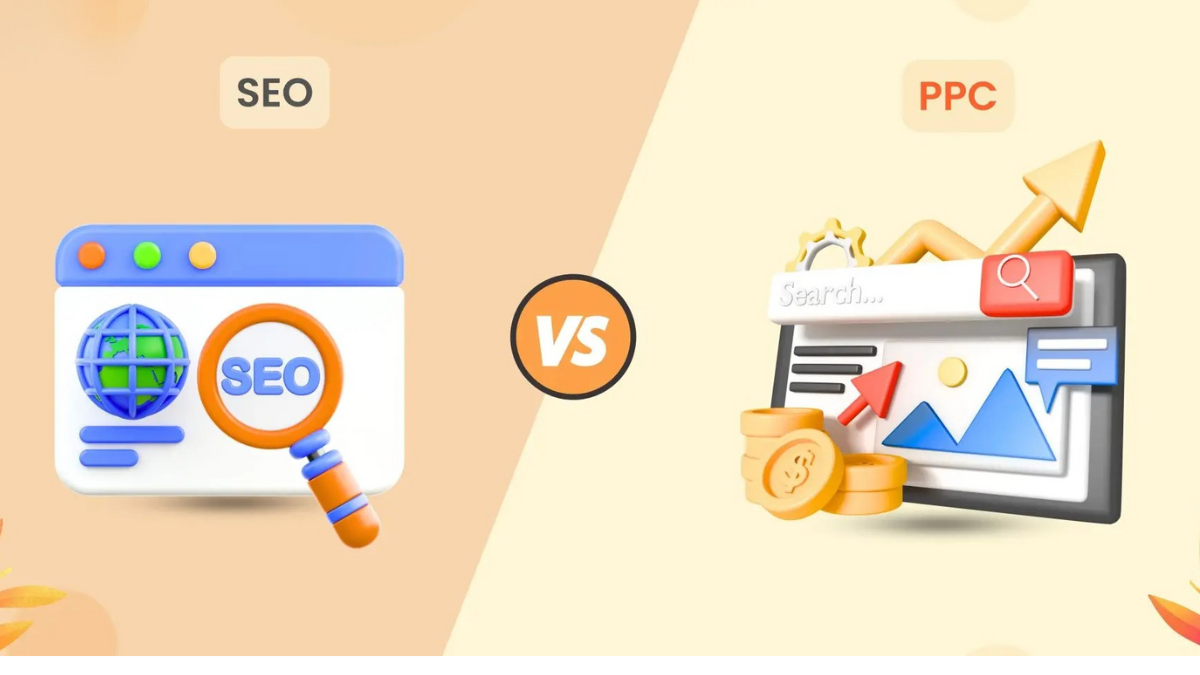
In today’s digital world, businesses in the United States have a key decision to make. They can choose to invest in SEO or PPC advertising. With small marketing budgets and high expectations for results, making the right choice is crucial. It can mean the difference between great growth and wasted resources.
The reality is that SEO and PPC have completely changed how businesses gain online customers. Organic search marketing will create lasting visibility over time. In contrast, paid search campaigns can quickly bring traffic and conversions.
Understanding the difference between SEO and PPC is important for any business. Knowing when to use each method can help a business succeed in its market in 2025 and beyond.
This guide will explain what you need to know about SEO and PPC. It will cover their unique benefits and main differences. You will also learn how using both methods together can create a strong digital marketing strategy. This strategy will help you improve your online presence and return on investment (ROI).
What does SEO stand for?
Search Engine Optimization, or SEO, is the process of improving your website and content. This helps your site rank higher in unpaid search engine results. Therefore, when someone conducts a Google, Bing, or other search platform query for products, services, or information about anything related to your business, SEO helps your website rank high in those search results without paying per click for them.
SEO includes several related disciplines:
On-page SEO is a great way to improve individual web pages. It involves using keywords wisely, writing strong meta descriptions, and using header tags. Internal linking and high-quality content that meets user needs are also important. Every part of your page, like title tags and image alt text, helps search engines understand and rank your content.
Technical SEO addresses the backend elements that impact the ways in which search engines crawl and index your site. This includes improving site speed, making it mobile-friendly, using secure HTTPS, and creating XML sitemaps. It also involves adding structured data and fixing crawl errors. These steps help search engines access your pages better.
Off-page SEO builds the authority and credibility of a website through external signals, mainly backlinks from authoritative websites. When authoritative sites link to your content, search engines interpret this as a vote of confidence, improving your rankings. Off-page SEO includes brand mentions, social signals, and online reputation management.
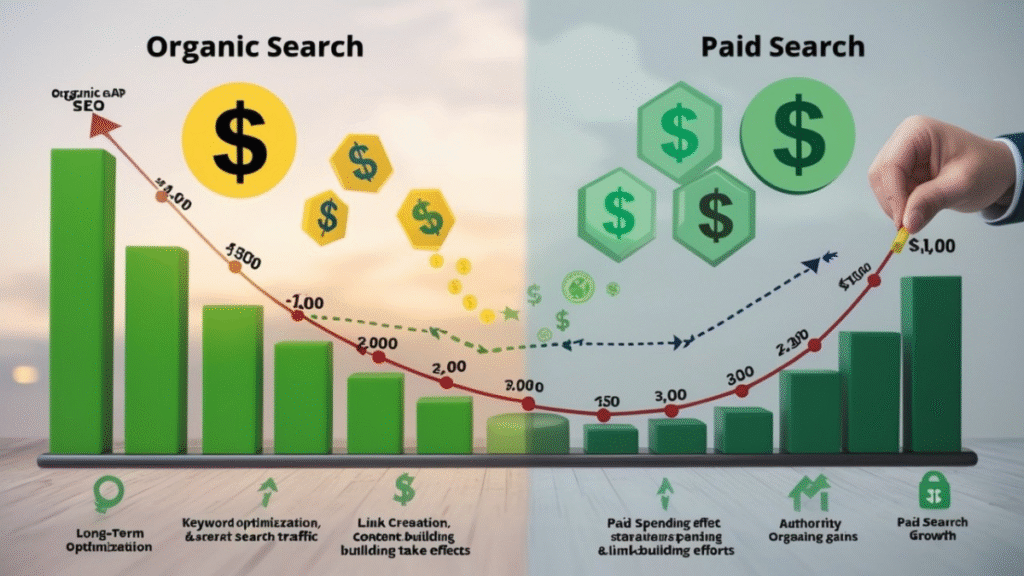
The beauty of organic versus paid search marketing through SEO is its compounding returns. Unlike paid advertising, where your visibility stops when you stop paying, SEO investments build equity over time. A well-optimized page can bring in traffic and leads for months or even years. This makes SEO a very cost-effective digital marketing strategy for long-term growth.
But with SEO, success is not instantaneous. Results usually take three to six months to show up. However, it can take 12 to 18 months for full maturity. This depends on the competition and how well the plan is put into action.
What is PPC (Pay-Per-Click Advertising)?
In the pay-per-click or PPC digital marketing model, businesses pay a fee each time someone clicks one of their ads. Essentially, you are buying visits to your site instead of attempting to earn those visits organically.
The most popular PPC platform is Google Ads. However, businesses also use Bing Ads. They advertise on social media like Facebook, Instagram, and LinkedIn. Display networks are also used for advertising.
Knowing how campaigns around PPC work will help in evaluating SEO vs. Google Ads. Advertisers bid on particular keywords relevant to their business. When users search for those keywords, an auction decides where ads will appear.
Ads can show in sponsored results above or below organic listings. The placement of your ad would depend on your bid amount, ad quality score, and the relevance of your ad to the search query.
PPC campaigns offer numerous advertising formats:
Search Ads show at the top and bottom of a search engine results page when users search for your targeted keywords. These text ads have a headline, description, and URL. They aim to attract searchers who are looking for solutions.
Display Ads are banner ads shown on millions of websites in Google’s Display Network. These build brand awareness and you can use them to retarget visitors who have visited your site.
Shopping Ads let you display your products with images, prices, and business names in search results. This is perfect for eCommerce businesses that want to boost product sales.
Remarketing Ads target users who previously visited your website but didn’t convert, keeping your brand top-of-mind and encouraging them to return and complete their purchase or inquiry.
The defining characteristic of PPC is immediacy. You can launch a campaign today and drive qualified traffic to your website in a matter of hours.
PPC is very helpful for promotions and product launches. It is also great for businesses that need fast results. This is especially true while they develop their SEO strategy.
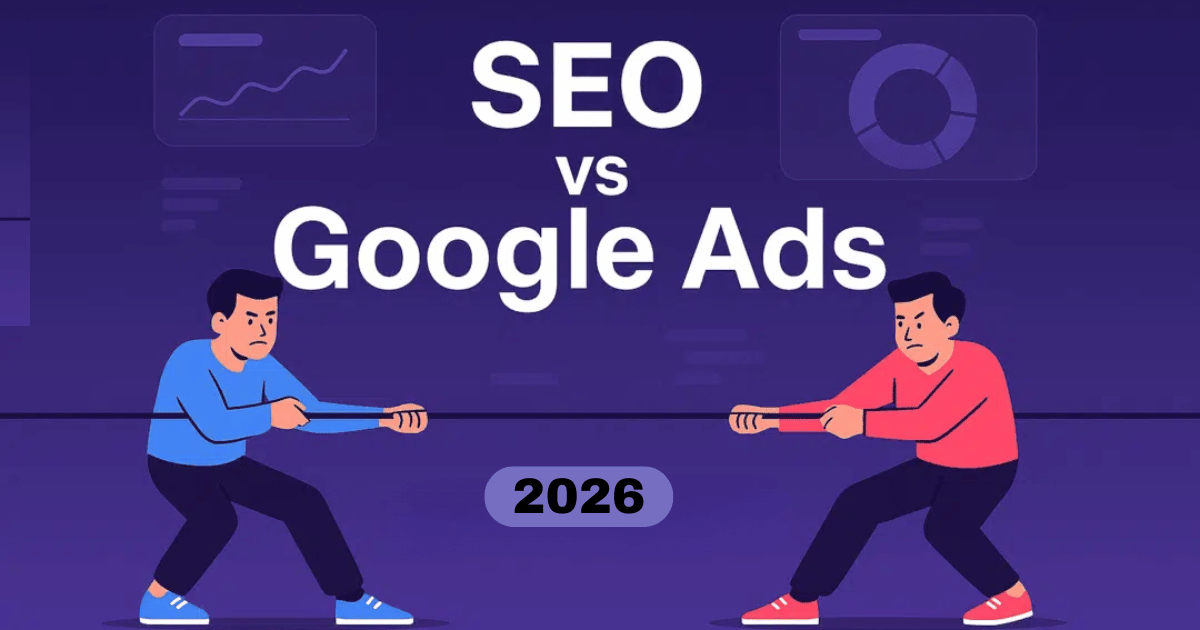
SEO vs PPC: What’s the Difference?
Understanding the main differences between these methods will help you make smart choices about your marketing budget.
Cost Structure
SEO involves content development, technical optimization, link building, and continuous improvement. You might not be paying per click, but you’re nonetheless investing in expertise, tooling, and time.
The advantage? Once you get good rankings, organic traffic is free for each visitor. This greatly lowers the long-term cost of acquiring customers.
PPC is a pay-to-play platform. Every click costs money, and that money varies wildly depending on the competition within the industry. attorney services might pay $50+ to find competitive keywords, whereas a niche B2B service might be happy to pay $5-15. The second you stop funding campaigns, your visibility disappears in an instant.
Timing and Results
This perhaps is the sharpest contrast between SEO and PPC. PPC gives immediate results; traffic can start flowing within hours of launching the campaign. That makes it perfect for seasonal promotions, event marketing, or businesses needing quick lead generation.
SEO builds momentum gradually. Initial results might appear after 3-6 months, and notable traffic gains would normally materialize between 6-12 months. However, this slower start compounds into sustained, long-term visibility that doesn’t disappear when the budgets get tight.
Visibility and Positioning
Pay-per-click advertisements appear at the utmost top of search results, labeled “Sponsored” or “Ad.” This premium property commands visibility from high-intent searchers prepared to act on a purchase. However, studies show 70-80% of users bypass paid ads altogether, opting for organic results.
SEO places your website in organic listings, which often start below the paid ads. The top organic positions receive the majority of clicks from users who trust organic results more than paid advertisements. Ranking in the top three organic positions can drive huge traffic without ongoing costs per click.
Sustainability
SEO and pay-per-click strategy differ fundamentally in sustainability. SEO builds lasting assets-quality content, authoritative backlinks, and technical excellence continue to pay dividends ad infinitum. Even if you reduce SEO investment, rankings decline gradually rather than instantly.
PPC offers no residual value whatsoever. The moment you pause campaigns, traffic stops completely. All previous spending offers zero residual value, meaning continuous investment is always required to maintain visibility.
Click-Through Rates and Trust
Organic results are more trusted by users than paid ads. Organic listings usually get more clicks for informational searches. However, paid ads perform better for commercial and transactional searches where users want to buy.
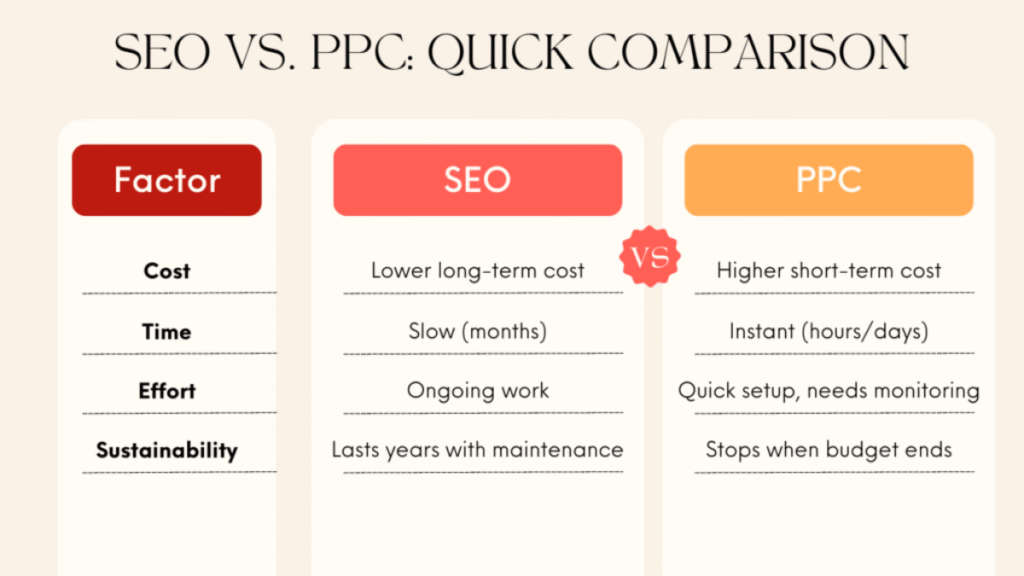
SEO vs PPC: Quick Comparison Table
Factor | SEO | PPC |
Cost | No per-click costs; investment in content & optimization | Pay for every click; ongoing budget required |
Results Timeline | 3-6 months for initial results | Immediate (within hours) |
Longevity | Long-term, sustainable visibility | Stops when budget ends |
Position | Organic results (below ads) | Top of search results (marked as “Ad”) |
Click Costs | Free clicks once ranked | Continuous cost per click |
Trust Level | Higher user trust | Lower (users skip ads) |
Traffic Control | Limited control over volume | Full budget/traffic control |
Targeting | Keyword-based | Precise (demographics, location, device, behavior) |
ROI Timeline | Better long-term ROI | Better short-term ROI |
Maintenance | Ongoing optimization needed | Continuous management required |
Competition | Difficult in saturated markets | Accessible if you have budget |
Best For | Long-term growth, brand authority | Quick results, promotions, testing |
When to Use SEO vs PPC for Your Business
The best digital marketing strategy for USA businesses depends on their specific situation, goals, and resources.
Choose SEO when:
You build a long-term, sustainable online presence. Organic visibility that grows over time, without higher costs, benefits startups and small businesses. It helps them build market authority.
Your industry has reasonable organic competition. If you are in a niche market or can use long-tail keywords, SEO is a good way to gain visibility. You can do this without competing against large corporations with million-dollar PPC budgets.
You have information worth sharing. Businesses that have knowledge or a unique view can use content marketing with SEO. This helps them become leaders in their field and attract the right audience.
Your customer journey consists of research and consideration. For big purchases or complex sales, buyers often do a lot of research. Ranking for informational and comparison keywords helps you become a trusted resource during their decision-making process.
Choose PPC When:
You need immediate results. Product launches, seasonal promotions, or time-sensitive campaigns require immediate visibility that only PPC can provide.
You’re testing the market demand. PPC helps you quickly check if keywords are profitable and if your messages work well. This is useful before you invest in long-term SEO.
Your industry is fiercely competitive organically. It takes years to rank above established competitors in many industries. Paid search gets you in front of your target market now while your SEO matures.
You’re running location-specific campaigns. The geographic targeting of PPC makes it perfect for businesses serving specific markets or running regional promotions.
SEO vs. PPC for Small Businesses
Small businesses have constraints in many ways, and this decision would most definitely reach a wider impact. With very limited budgets, investment decisions should be well considered.
In general, an investment in foundational SEO will pay dividends over time for most small businesses. Creating a well-built website with good content is important.
Focus on local and niche keywords. Also, set up citations in online directories. This approach helps you gain lasting visibility without ongoing costs for clicks.
That said, supplementing with small PPC campaigns targeting high-intent keywords can kickstart lead generation while you gain momentum on SEO. The key is to think of these tactics as complementary and not competing alternatives.
Combining SEO and PPC for Maximum Impact
The best marketers do not pick between SEO and PPC. They use both wisely to lead in search results and increase conversions.
Increased Visibility and Brand Presence
When you show up in both paid and organic results for the same search, your visibility increases a lot. Users see your brand multiple times on a single results page, building familiarity and trust. Oftentimes, it leads to better overall click-through rates than either channel alone.
Data Sharing and Insights
With PPC campaigns, you get immediate data on keyword performance, conversion rates, and messaging effectiveness. These insights help shape your SEO strategy. They show which keywords to target and which content themes your audience likes best.
On the other hand, SEO shows you which organic keywords yield the best quality traffic and conversions. You can then amplify these winners with PPC for maximum impact.
Covering All Buyer Journey Stages
SEO does an extraordinary job of capturing users at each phase of research and consideration with informational content. With PPC, it’s when users are prepared to buy: targeting high-intent, commercial keywords. Together, they create comprehensive funnel coverage, from awareness through conversion.
Remarketing Opportunities
Users who find you through organic results and don’t convert immediately become your remarketing audiences for PPC campaigns. This follow-up method keeps your brand in people’s minds. It encourages them to come back, which helps increase conversion rates.
Budget Flexibility
When SEO rankings go up for important keywords, you can reduce or stop PPC spending for those terms. You can then use that budget for new opportunities or other channels. This flexibility optimizes your marketing spend while maintaining visibility.
Competitive Advantage
While competitors debate SEO vs. PPC, businesses that implement integrated strategies capture more market share. Ranking high in both paid and organic search results makes it hard for competitors to be seen in your area.
SEO vs. PPC Pros and Cons
Knowing the benefits and drawbacks of each method will help you make smart choices for your business goals.
SEO Benefits:
- Cost-effective long-term traffic generation, with no per-click costs.
- Builds sustainable, compounding visibility over time.
- Higher trust and credibility with users who prefer organic results.
- Comprehensive brand visibility across many search queries.
- Creates valuable owned assets: content, rankings, authority.
- Better click-through rates for informational and research queries.
- Continues to realize value with even less investment.
- Improves overall website quality and user experience.
SEO Disadvantages:
- Requires at least 3-6 months to deliver appreciable results.
- Requires continuous investment in content and optimization
- Algorithm updates have unexpected effects on rankings.
- Very competitive fields have high resource inputs.
- Difficult to predict exact ranking outcomes
- Less precise targeting compared to PPC demographic options
- Requires specialized expertise or agency partnerships
PPC Advantages:
- Immediate visibility and traffic generation
- Precise targeting by demographics, location, device, and behavior
- Complete Budget Control with Adjustable Spending Limits
- Precise performance tracking and ROI measurement
- Ideal for time-sensitive campaigns and promotions
- Quick keyword, messaging, and landing page testing
- Guaranteed visibility regardless of organic ranking ability
- Effective remarketing to re-engage prospects
PPC Disadvantages:
- Continuous spending to maintain visibility.
- Costs per click can be expensive in competitive industries.
- No residual value when campaigns pause.
- Lower trust compared to organic results.
- Requires continuous management and optimization.
- Click fraud and invalid traffic waste budget.
- Ad blindness reduces effectiveness over time.
Decreasing ROI due to increasing competition, which in turn raises the prices of bids
Choosing a Strategy That Serves Your Goals
It aligns the entire digital marketing approach towards a certain business objective, ensuring better return on investment.
To Build Brand Awareness: Use SEO content marketing along with display ads and social media PPC. This will help your brand be seen across different channels.
E-commerce Sales: Focus on product-centric SEO by optimizing your category pages and enhancing product descriptions. Complement this with Google Shopping Ads and remarketing campaigns to capture ready-to-buy shoppers.
Local Businesses: Focus on local SEO. This includes optimizing Google Business Profiles and local citations. Also, run geo-targeted PPC campaigns during busy seasons or to promote specific services.
For startups on a budget: Lay SEO foundations first: technical optimization, essential content, and basic link building. Add small, highly targeted PPC campaigns for your most valuable keywords to generate initial customers while organic visibility develops.
For Established Businesses: Create complete programs where SEO brings steady traffic. Use PPC to grow during busy times, support new projects, and capture extra demand in competitive areas.
The best approach looks at your budget, timeline, competition, and growth goals together. It does not see SEO and PPC as separate options.
Partnering with SEO & PPC Specialists: The Key to Maximizing ROI
Success in modern search marketing depends on expert knowledge and proven methods. It also requires the ability to adapt to changes in algorithms and market trends.
Professional digital marketing agencies bring a number of critical advantages to bear for your campaigns. As they gain experience, strategists will see the key differences between SEO and PPC.
They will create plans that use the strengths of each method while reducing their weaknesses. This kind of thinking helps avoid the common mistake of seeing these as separate projects. Instead, they should be viewed as parts of a unified strategy.
Technical expertise ensures proper implementation. SEO involves an understanding of schema markup, Core Web Vitals, mobile optimization, and hundreds of other ranking factors. PPC requires expertise in Quality Score optimization, bid strategies, audience segmentation, and conversion tracking. Few businesses retain this deep knowledge internally.
Access to premium tools and resources amplifies results. Professional teams use keyword research tools, competitive analysis tools, rank tracking systems, and analytics software. These tools can cost businesses thousands of dollars each month.
Proven processes and methodologies translate to your campaigns benefiting from experience across hundreds of clients and industries. It means agencies understand which tactics work well and which ones waste resources. They also know how to change their methods for different business models and competition.
Continuous optimization makes sure your campaigns evolve with the market conditions. Algorithm updates, competitors’ moves, and shifting consumer behaviors require ongoing monitoring and adjustment. Dedicated teams provide this ongoing optimization without distracting your internal resources from core business operations.
When bringing on new partners, focus on agencies that have strong skills in SEO and PPC. Look for those that are clear in their reporting and have proven results with businesses like yours. Choose agencies that think strategically, not just tactically.
Frequently Asked Questions
Which is better, SEO or PPC for long-term
growth? Yes, SEO generally provides better long-term ROI since it creates sustainable visibility with no ongoing per-click costs. Once you reach high organic rankings, they keep bringing traffic and leads for months or years with little effort.But again, the “better” of these two depends on your timeline and goals.
Combining the strategies works best for those businesses needing to see immediate results while building long-term assets.
How much should I spend on SEO or PPC?
The right budget allocation depends on your industry, competition, and stage of growth. Most businesses spend about 60-70% of their digital marketing budgets on SEO. This helps them grow steadily. They use 30-40% for PPC to get quick results and seize opportunities.
Small businesses may spend $2,000 to $5,000 a month on marketing. In competitive industries, costs can rise to $10,000 or more each month. The key is starting with budgets sufficient to achieve meaningful results rather than spreading resources too thin across channels.
Can SEO and PPC be used together?
Absolutely, this is the most powerful digital marketing strategy that businesses in the USA can apply.
SEO and PPC work together to improve search visibility. They provide performance data, help with buyer journey stages, and offer budget flexibility.
Businesses dominating
both paid and organic results capture significantly more market share than competitors using only one approach. Which provides quick results, SEO or PPC?
PPC generates immediate results, sometimes in hours after the campaign went live.
SEO takes at least 3-6 months before serious results start appearing, and its full maturity happens within 12-18 months. This makes the time difference so vast that PPC is ideal for immediate needs and SEO for long-term value.
Savvy businesses are using PPC to generate revenue early so their SEO investment can mature. Which would be more economical over a long period?
SEO becomes dramatically more cost-effective over time because organic traffic has no per-click costs. While the initial investment in SEO may be high, the cost per acquisition decreases over time. This happens as rankings improve and traffic increases.
With PPC, you need to keep spending to stay visible. Costs can increase over time if competition raises bid prices.
Most businesses find that SEO provides better lifetime value, and PPC offers superior short-term predictability and control.
Take Your Digital Marketing to the Next Level
In the debate of SEO versus PPC, one truth stands out: successful businesses do not pick one strategy. They use both to lead their market and increase their return on investment.
Small businesses and large companies both need to grow. To do this, they must focus on their online presence. A good strategy includes both organic and paid search marketing.
Understanding how these strategies work together changes your marketing. It turns tactical campaigns into a complete system. This system builds brand authority and captures demand at every stage of the funnel. It also helps you spend money wisely to get the best returns across all channels.
Which strategy, or combination, will drive optimal results for your business?
Our team of digital marketing experts creates custom SEO and PPC strategies. We work with your goals, budget, and timeline. We have helped many businesses in the United States get first-page rankings. We also help lower acquisition costs and grow profitable campaigns.
Contact us today for a free strategic consultation.
We will analyze your current digital presence, identify your biggest opportunities, and design a roadmap that provides measurable results.
Don’t let your competitors dominate the search results while you’re still deciding. Let’s build your perfect marketing mix and start driving real business growth. Request your free consultation now and discover how the right SEO and PPC strategy can transform your business